The Wisdom of Art School

Several months ago I began an article about the wisdom of going to art school.  I tucked it away and never published it.  This morning my sister posted a link to an article on Huffington Post with a very similar rationale in which she was quoted.  http://www.huffingtonpost.com/2013/10/10/art-and-music-schools_n_4078962.html?utm_hp_ref=fb&ir=Arts&src=sp&comm_ref=false.  I think it’s a good time to share my two cents as well…

As a twenty-first century feminist, I have concluded that the most salient advice I can give my children when it’s time for them to apply to college is to go to art school. 

Last week I attended a lunch with Aayan Hirsi Ali entitled “Feminisim in the Twenty-First Century” sponsored by the Asia Society in Hong Kong.  Ms. Ali’s primary point was that the modern, western view of feminism has lost its way and should return to its origin.  Feminism used to focus on equal opportunities, but has recently evolved to focus on equal outcomes.  Since women will always be the bearers of children and hence always the ones to struggle with work/life balance, she posits that instead of focusing on breaking glass ceilings, women should return our focus to the protection of women – from trafficking, violence, FGM and other horrors — and ensuring women are equal before the law. 

Then I attended a screening of Missrepresentation, the award-winning Sundance movie about how the media exploits women.  The compelling film suggests that women need to focus on breaking that glass ceiling, getting on the corporate boards of media conglomerates to gain control and power over what we watch and how women are portrayed.  Similarly, Sheryl Sandberg, in her book Lean In, provides a solid argument for women staying in the workforce in large part for personal gain, to be able to regain work/life balance once we reach the upper echilons of our professions. 

So, break the glass ceiling, fight for the rights of the world’s under-served women, lean in, lean out, off ramp all while raising a family of my own?  What’s a woman to do?   Go to art school.  

Consider the benefits of art school. Art school prepares artists and art lovers with skills to do things they love.   Starting from a place of inspiration and purpose, a career can be built from the inside out instead of the other way around.   Practically speaking, an art degree is a lot more family friendly than a business degree, enabling the graduate to design and build a life around tangible skills, rather than just riding the coattails of a prestigious institution.  

Secondly, a hallmark of art school is the dreaded “crit.”  Vulnerable art students face the analytical wrath of their fellow classmates and professors as they present and defend their conceptual art to pass their classes.  A mediocre artist with a highly evolved conceptual ability and a quick wit will sometimes do better than a wishy-washy technically talented artist.   Consider the resilience and thick skin that comes from surviving the dreaded “crit”, desperately needed skills in the day of armchair quarterbacking and anonymous commenting.  

Finally, with a relentless barrage information streaming continuously, we are no longer informed by a finite source of arguably unbiased information (like the newspaper or evening news), but instead have an endless supply of input at our fingertips.  We gorge on our favorite sources, gagging on the soundbites we repeat without critical thought.  Every website in our portfolio reinforces our beliefs without dissenting voice.   It’s the age of INFOBESITY.   To keep our heads above water and our thoughts critical, we need to be curators of information, rather than blind consumers.  The extent to which we are able to put together a well culled, thoughtful, deliberate collection of topical inputs determines our competitiveness in the workplace, desirability at dinner parties, and success as architects of our own futures.  Where better to learn to curate a collection than art school?

My sister chose to go to art school.  At the time we thought what most people think when they hear a high school senior is off to art school.  What is she going to do with that?   The fact that it is arguably the best art school in the country, the Rhode Island School of Design helped, but didn’t completely assuage the concerns of how she’d put food on the table.  Twenty years later, she is the Associate Director of Admissions for RISD, exhibits annually at the alumni art sale, creatively inspires my niece with her own art work and easily puts food on the table.  She leaves work at 5, doesn’t work weekends, has flexible hours in the summer and an exciting, upwardly mobile career path, and now she’s quoted in the Huffington Post.  Starting from a place of inspiration, her professional life has fallen into place well.  I’d say that’s a success story, and a great endorsement for the power of an art degree. Go Lu!


RAMP… on or off, we’re still moving forward.

 Ever since I read Sheryl Sandberg’s Lean In, I have been pondering the choices I made professionally and wondering if I should have “leaned in” along the way.   I love working and I have spent most of my life preparing for and participating in the workforce, but I also love being primarily responsible for raising my kids.  What I don’t love is feeling like I have to apologize for that choice.  In a perfect scenario, I could work around my family’s needs and contribute productively to society.  This idea led me to a thought exercise that with some energy and attention, might be a first step toward more seamless transitions for men and women in and out of the workforce along a life, not just a career, path…

RAMP… On or off, we’re still moving forward.

If work life is a journey to be traveled, rather than a destination to be reached, there are bound to be stops along the way.  Think of your career as one long, fun road trip.  You travel along, at first in a stroller, upgrading to a bike, your first car, a nicer model, a sensible minivan, the midlife crisis sports car and eventually a practical Subaru (avoid the wheelchair, if possible!) and then a nice porch rocker if you’re lucky.   But on any road trip, there are pit stops, exits and entrance ramps.  These are a natural part of any trip.   When you get off the freeway for a little break, you don’t abandon your car and never look back.  Instead, you park it for a while, rest, refuel and get back on your way. Why can’t your career be like this too?

What is RAMP?

  • RAMP is a network of individuals who view their career path as a journey rather than a destination, but who recognize the need to continue to grow, whether employed or not.
  • RAMP is a social movement designed to get society to stop valuing each other by our professions, but by our intrinsic character and essential selves.
  •  RAMP is a practical resource for skills building, networking, career curation, support and advocacy.
  • RAMP is a membership-based organization, app and website that links workers with employers, or needs with skills, for project based work for individuals who are taking a break from a career, but still want to be professionally engaged.

Goal

The goal of RAMP is to become a system for aiding the off ramping and on ramping of individuals from professional career paths to family care roles and back.  The goal is nothing less than raising both society’s labor productivity and also the overall level of emotional wellness in society.  Improving social productivity in this way is an increasingly urgent economic need given aging demographics in most countries and extensive welfare spending.

Need for RAMP

Many highly skilled and educated people, predominantly women, are dropping out of the workforce in order to assume the role of primary care provider parent in their own household.  With long work hours and complicated societal demands for engaged parenting, households that can financially afford a division of labor where one is the primary bread winner and the other the primary domestic manager are feeling forced to make this difficult choice.  Increasingly this has become an all or nothing scenario, which has created an economic inefficiency that should be addressed.   Educating a sector of the population that then fails to contribute directly to the economy is time consuming, expensive and inefficient.

Beyond the economic inefficiency of educating an ultimately “non-productive” sector, choosing to leave a professional life has psychological implications that negatively impact self-esteem, divorce rates, substance abuse and so on.  The Five O-Clock glass of wine that is joked about in just about every “mommy blog” or New Yorker cartoon is actually damaging and, I theorize, a sign of deep despondency and lack of satisfaction and happiness in life.

One of the biggest things a primary care parent misses is recognition, professional growth and feedback.  Volunteering for worthy causes can help alleviate that, but for individuals to truly engage in nonprofit volunteer work they need and deserve a more formalized system of recognition and feedback that contributes to the continuity of their resumes.  This will improve the quality of the commitment volunteers make to the causes as well.

  • A  Harvard Business Review survey found that 37% of highly qualified women were “off-ramping” (voluntarily leaving their job for extended time periods) and that “three quarters [of the women surveyed] were on nonlinear career trajectories to the detriment of their earning potential and career advancement.” (HBR Magazine, June 2010).
  • With due respect to his holiness the Dali Lama who believes that happiness is the ultimate goal, we RAMPers believe that happiness is the byproduct of finding and living one’s purpose.  Viktor Frankl’s “knowing the why enables you to bear almost any how.”
  • The root of the mommy wars is not judgment of the other, but vulnerability and guilt.
  • Answering the dreaded question, “What do you DO?”

RAMP can address these issues by helping primary care parents maintain their professional skill set, sense of self worth and purpose by keeping them responsible to continually contribute to the world beyond their own families.   Rather than just drop out altogether, RAMP helps individuals create a work plan that will enable them to continue to build new skills and keep old skills fresh, and to take on projects that utilize their professional talents but still maintain schedule flexibility which is the single biggest need for primary care provider parents.

Possible components of RAMP:

1.  On-line database for skills-based project work – For people with specific skills who don’t want to work full-time, but could take on projects.  The employer doesn’t have to pay benefits and can get specialzed skills and expertise that they don’t have to have in-house without making a long-term employment contract decision.   Similar in concept to legal services firm, Axiom, individuals could even eventually work for RAMP and be hired out for projects, getting insurance and other benefits from RAMP.

2.  Political Advocacy – Want to make a real difference?  Join the RAMP Advocacy Team in being an advocate for primary care parent protection by lobbying to make changes at the government level.  Could social security benefits be shared for couples who choose to have one parent stay home to take care of children?  Paternity leave benefits?  On-site child care?  Do research and let your voice be heard to help other families navigate these important decisions better in the U.S.

3.  Networking & Community Organization – There is power in numbers.  One of the biggest concerns of stay-at-home parents is the isolation and lack of professional network they had when they “really worked.”  RAMP offers both an on-line and in-person gathering for members.  Those in the same city can meet in a common location to work together, bouncing ideas off each other and perhaps sparking innovation.  Another example would be an increased efficiency and transparency to alleviate the mommy wars.  Instead of “stay-at-home-moms” feeling put upon by working mothers who continually ask for favors without reciprocating, organize a system where stay at home moms help working moms on an up-front basis and get some kind of compensation/recognition for it rather than favors with judgment.  Mothers could join the after-school brigade coordinating carpool rides to after-school activities, hosting homework groups at their houses and so forth.  Working mothers would know that their kids were in the hands of other mothers.  Working mothers would spend RAMP stamps by the hour, while stay-at-home parents who agree to volunteer earn the stamps.  RAMP Stamps can be spent to sponsor other members, or for guidance, personal training etc.

4.  Alternate Currency – An alternate structure for RAMP might include a website/app that would match skills with needs and earn members a form of currency called RAMP Stamps.  The website would keep track of bankable hours that could be spent for other services by RAMP members.  For example:  One RAMP member is an accountant.  She is “hired” by another member to create a family budget, which takes her five hours.  She banks five RAMP Stamps.  The accountant then decides she wants a balcony garden and finds a landscape architect through RAMP to plant a garden for her, which takes four hours.  She spends four of her RAMP stamps on the garden.  The landscape architect wants to relax with a regular yoga lesson, so she finds a yoga teacher on RAMP and spends her earned RAMP stamps, one hour at a time, on yoga and so on.   The transaction requires feedback from both parties, but no cash outlay.  This gives the “employee” a professional track record that helps keep the resume current and growing even though she isn’t formally employed at the time.   It also gives the “employer” services without spending money, an issue for non-income-earning spouses.  Modeled on Paperless Post’s stamps, RAMP Stamps can also be used to sponsor other RAMP members who can’t afford the membership fees or be spent on needed services.  This will build the RAMP network along socio economic lines and encourage the spirit of RAMP in helping people help others.

Clearly this is a half baked thought exercise, not a business plan, but I wonder if it resonates with you and if you have any additional thoughts?  

Random Path Generator of Life

Today is National Day in Hong Kong. I can’t imagine it could be as unusual as the one I spent a few years ago and describe here… 

Image 1

On October 3, 1990, a pudgy college senior studying abroad in Vienna, I stood at the Brandenburg Gate in Berlin and watched as the flag of reunited Germany was raised for the first time.  I hadn’t intended to go to Berlin for the unification, but Oktoberfest had been more like “drunken grope-fest” and my travel mates and I needed a good night’s sleep.  So, with our Eurail passes we boarded a night train to Hanover (a solid eight-hour destination) then figured we might as well check out this unification thing in Berlin since we were so close.  It was surreal.  I chipped my own souvenir piece of the wall with a rented hammer from an entrepreneurial German (I still have that piece), wandered the streets of East Berlin with the buildings eerily lit for dramatic effect, crossed Checkpoint Charlie and explored the museum.  As I stood at the gate at midnight on the West Berlin side, champagne corks and fireworks exploded and Ode to Joy played.  A stranger handed me a cup and we all toasted the occasion. I was moved by the celebration and the hopefulness of the people around me.

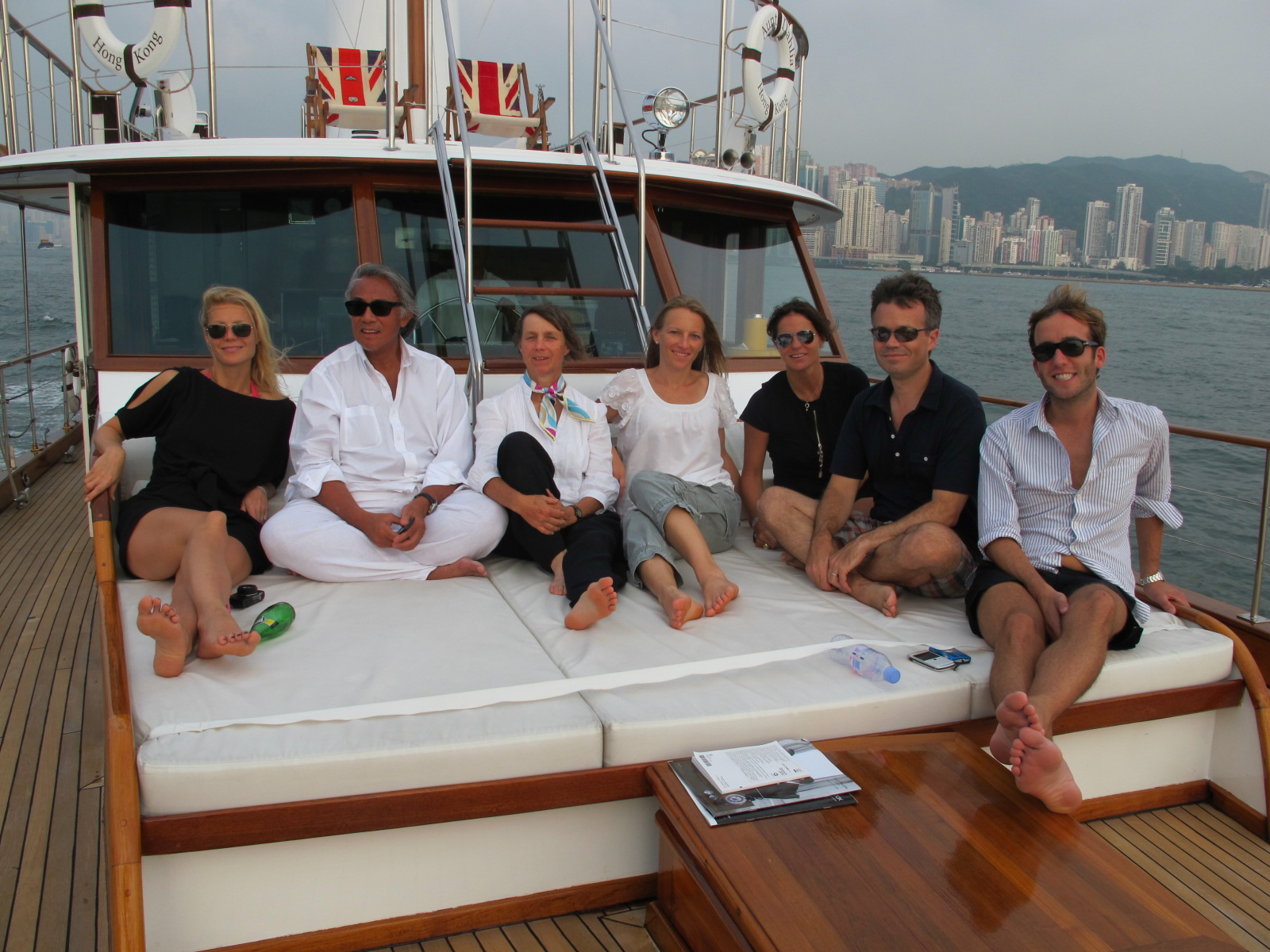
Very few days generate the detail of recall as that day, so every October third I tend to reflect on the unpredictable path that led me from the Berlin Wall to my present circumstances whatever they are each year.  So twenty years later, the random path generator of life blew a fuse and put me in a bikini on a yacht in HK with my husband, mother, Hong Kong living legend Sir David Tang, and Gwyneth Paltrow.

I had known since the spring that entirely by coincidence, my mother and Gwyneth would both be visiting Hong Kong during the first week of October. Mom for her annual kid visit and as a stop on her book tour, and Gwyneth to film a scene for Steven Soderberg’s upcoming movie, Contagion. Still, I had no idea what the week would bring and didn’t even know if we’d see Gwyneth.

Mom arrived first and jumped right into a few book related events we had arranged.  She’s a total pro.  She spoke at St. John’s Cathedral to a group of parishioners, teachers, and others who had heard about the talk.  It was well received and she sold a lot of books.  The next day I had organized a brunch at my house and invited 40 women.  I made my favorite recipes and, though it was originally planned as an open house, mom ended up giving an impromptu talk to the group that was provocative, challenging and inspiring for these worldly, but content-starved women.  It was a very nice morning, and I am so glad that we already had these two events under our belts before the crazy weekend ensued.

Gwyneth had sent me a text, “Friday night! Let’s go!! I am so excited!”  While I was excited to see her, I felt a bit of pressure, as her evening arrival coincided with National Day (many things are closed and the streets are thronged with people watching the largest fireworks display of the year), and, plus, just how do you take a celebrity out on the town for her very first introduction to HK?  I enlisted two trusted friends and, after considering a zillion options, settled on a plan.

My “entourage” that night consisted of my husband, mom, Sonya, Louis and eight-month-pregnant Kelly.  At the last minute Louis asked if we wouldn’t mind if a friend of his visiting from London joined us for drinks.  Turned out to be Dambisa Moyo, the Zambian, Harvard & Oxford, PhD, author of Dead Aid:  Why Aid is not Working and How There is a Better Way for Africa and on the Time Magazine 100 most influential people list.  “Sure.” I said.

I had insisted that GP switch hotels and stay on the Hong Kong side, as the selected hotel for her would have been impossible to reach and too crowded with the National Day celebrations going on.   We had organized a private table at the bar at the Upper House and arranged to meet for drinks there to watch the fireworks.  I had to laugh when she texted to ask me what I was wearing (now I can say that I loaned money to a Kennedy AND gave fashion advice to a cover model!).  This turned out to be a spectacular view of the fireworks and a nice way to ease into the evening, although Dambisa arrived wearing a flashing devil horn headband with her own entourage of about ten oil guys who were quite enthusiastic about the party they had just joined.  Everyone handled it gracefully, and we managed to extract ourselves from the group and head to dinner.

After much deliberation and a hundred restaurants selected and then discarded, and at the advice of several in-the-know women, I eventually settled on a private Szechwan kitchen, Da Ping Huo on Hollywood Road, known for great spicy food and the wife of the chef who comes out and sings Shanghainese opera after the meal.  I thought it would be a real authentic and not cliché HK experience.  Well it was that, but sadly the food was rather inedible.  We were the only party in the five-table restaurant (save for one lone male European tourist).  Fortunately, Frenchman Louis had brought along some nice wine & champagne so what we lacked in food we made up for in beverage.  At least in a tiny, empty restaurant we could all really talk and get to know one another. Gwyneth is as interesting as she is graceful, so no complaints around the table.  Her charming assistant Kevin was a delightful addition to the party too.  The opera serenade was a riot, and overall the experience was fun, but it was unfortunate that the food was not great.

Mom was the first to peel off from the group, sensibly heading home after dinner.  The rest of us headed to a private club called Kee.  We walked there, and on the way a few people stopped her for photographs, but other than that she wasn’t bothered by paparazzi the whole time in Hong Kong.  Kee was great fun, dancing!  After some time on the dance floor with GP (nearly sending Kelly into pre-term labor!), they headed home and the remainder of our group eventually headed to another club under the escalator called Drop.   It is a wild experience to walk into a room and immediately have the best table cleared for you and champagne corks start popping.  We stayed until 3:30 am, then Gwyneth, my husband & I headed out.  Sonya stayed and showed Kevin the late night scene.  We dropped GP and were home by 4, the latest we’ve been out in years.

My husband takes the total dad-of-the-year prize for getting up to take our oldest to a shade-less soccer field in Kowloon by 8:30 the next morning for a four-hour tournament.  He came home and slept all afternoon!  Just as we were getting home from a difficult dinner in Stanley with the kids Saturday night, my mobile rings and I hear, “Gwen?  This is David Tang.”  “Oh hey!” I answer as if we’ve been friends for years.  He’s calling to organize sending a car to pick us up for lunch at his house in Sai Kung the next day, then an afternoon on his boat.  He had met Gwyneth previously and extended the invitation to her, which she insisted on extending to us.  O-K…

Sunday was a day of hilarious contrasts.  Probably the most unusual day I have ever spent… well, except the birthday I spent in Somalia when I visited the USS Tarawa by CH-46 helicopter and met Audrey Hepburn on the tarmac in Mogadishu, but that’s another story…

Sunday was Harvest Festival at St. Stephen’s church in Stanley and, since it was Pastor Will who had invited mom to speak at the cathedral and because we have been making an effort to go there, we all rallied and went to church.  After, we dropped the kids at a friend’s house, quickly walked Finchley and then headed out in David Tang’s white Range Rover with his driver Alex.  I must admit that before all of this started, I had never heard of David Tang.  I soon learned that he’s a Hong Kong entrepreneur, founder of Shanghai Tang, China Club and many other hot restaurants in Hong Kong and London.  He has also been knighted by the Queen, enjoyed a private audience with the Pope, writes regularly for the Spectator and FT, has the exclusive distribution rights for Cuban cigars for Asia and is an all-around character and self-described “maximalist.”

His driver took us to David’s country house out in Sai Kung. The house is located on a large, lush lawn stretching to a beautiful sea view, and is full of things he loves like dogs, books, good reading light and cigars.  David’s wife Lucy is a British woman who has channeled a penchant for intense socializing into excessive exercise and now competes in ultra-marathons on every continent in one year.  She has already completed the Gobi and Sahara deserts and is off to Antarctica for the next one.  When we arrived David told us that GP had gone to dim sum and so was delayed by an hour.  That meant that we were to make conversation for the next hour with a man seated next to a photograph of himself with the Pope.  Mind you, mom’s book is a controversial take on Mary Magdalene’s role in Christianity and does not look entirely favorably on the institution of the church.

David was a total pro, though, accepting a signed copy of mom’s book and offering her one of his own signed “To Cynthia. From your acolyte, David Tang.”  Eventually GP & Kevin arrived and we headed to lunch under a tent on the lawn for a great meal prepared by his Sri Lankan staff.  I was seated at the head of the table next to David.  At one point David sat in his chair and leaned back. For a split second I thought of grabbing his thighs to stop him from toppling over, but in my hesitation as I pondered what that would look like if he wasn’t really about to fall backwards, he actually did.  Fortunately he tucked up his head, or he might not have lived through lunch, as there was a concrete drain eerily close to the spot he landed.   He jumped right back up into his seat — an impressive feat for a not insignificant man — and the meal continued.  The conversation turned to organic produce and, as that is a regular topic of the non-working Southside mom set, I launched into a tale.  But, just as  I began the story, I felt a warm wet sensation on my Chloe-clad foot.  I looked down to discover that their dog was peeing on my shoe!  I still wonder if the dog was poorly, or very well trained?

IMG_1087

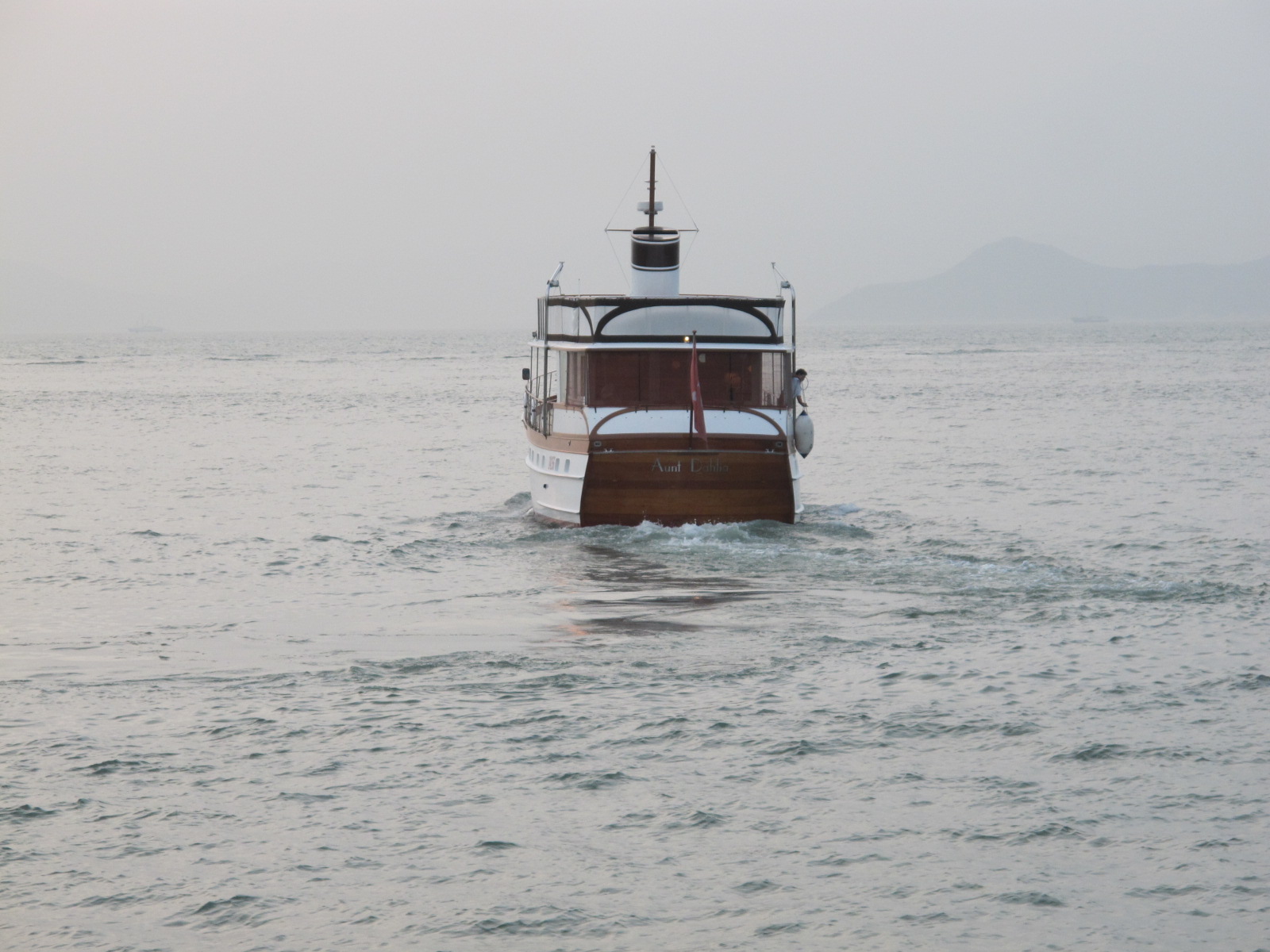
The meal complete, and a ceremonial cigar with David (how could my husband turn down a Cuban offered by their honorary ambassador?) we headed out to board their fancy “ocean-liner of old” style yacht.  We sat up on the top deck admiring Sai Kung, but one by one we peeled off for bathing suits. GP came out in a tiny pink bikini looking entirely glamorous.  I gulped hard and decided not to care and donned my own army green bikini.  Who’s looking at me anyway?!  We had just had a discussion of the dodgy water quality in HK and Mr.E’s mysterious viral water warts that his doctor had said probably came from swimming in the ocean.  So GP hesitated on the deck for an awkward several minutes after the rest of us had jumped in, probably doing a mental calculation of the risk and reward of a refreshing swim, making her singing debut at the CMA covered in water warts, and the commercially beneficial irony of actually catching a virus while filming the movie Contagion in which she is patient zero for a devastating virus that sweeps the world.

We sailed into Victoria Harbor at dusk as David held court about his views of the environment… “The real problem is not the birth rate but the lengthening of the lifespan.  If you really care about doing something for the environment, then DIE!”

Gwyneth had to meet with the director back at the hotel, so the boat docked at the star ferry pier in TST and she and Kevin debarked along with David & Lucy who were also heading off.  As we were scheduled to be on Lamma Island for mom’s appearance at the inaugural meeting of the Philosopher’s Club at the Bookworm Café, David sent us off on the yacht to Lamma.   This is how we found ourselves alone on a staffed luxury yacht in Hong Kong Harbor watching the sunset.  Go figure.

In a classic Hollywood tale, this would be the parting shot, us sailing off into the sunset, but I can’t quite end the story there, as the Lamma portion was a perfect antidote to the luxury day.  We arrived in Lamma with enough time for a quick seafood dinner at one of the local places where you point to your fish in a tank and it arrives a few minutes later on a plate.  Mom’s host met us at the restaurant and gave her the low down on the evening ahead.  Apparently, the poster his evangelical girlfriend had made for the talk had created a bit of a stir on this tiny island bastion of mid-sixties, Caucasian hippies and local fishermen, so the night portended to be quite interesting.

In fact, it was.  Completely random, awkward and a difficult set-up in a public café with half of the people there for the talk and the other half there to have dinner.  But again, mom handled it with her usual skill and the talk was well received and interesting.  She posed for a few pictures, sold a few books and we ran for the 9:30 public ferry.

So, since her visit, Gwyneth has guest- starred on an episode of Glee!, graced the cover of ELLE, made her country music singing debut at the CMA, promoted Jessica Seinfeld’s new cookbook and any number of other experiences.  For her, HK was an “interesting cultural experience” and is a distant memory.  For me, her visit was a glimpse of another world and a long slow exhale.  Now What?
IMG_1104

Cheerleader in Africa

IMG_0420

The confluence of three seemingly disparate events last week has my mind returning to the time I spent living and working in Africa more than twenty years ago.  My book group in Hong Kong chose Aayan Hirsi Ali’s book Infidel as our first book of the season.  Ali was born the same year as I, but at Digfer Hospital in Mogadishu, the very same hospital our medical team set up shop when we arrived to help in Somalia twenty-two years later.  Our book discussion took place one evening as the stand off at the Westgate mall, just miles from my former home in Nairobi remained unresolved.  Learning that the attack was likely planned by radicalized Somalis, precisely those Ali had described in her memoir, was disheartening.  Finally, reading Kathy Eldon’s new memoir, In the Heart of Life, makes it all seem like it was yesterday.  It makes me want to share this part of the story myself…

Twenty-two years ago, a recent college graduate, I was hired to join the first American medical relief team to respond to the growing humanitarian crisis in Somalia.  Siad Barre had fled the country and clans were aligning around two main rivals, Ali Mahdi and General Aideed, vying for power in a chaotic and dangerous war.  By November our team was doing the best they could under severe conditions at Digfer Hospital in Mogadishu.  Despite our best efforts and those of a few intrepid journalists, no one was paying attention to Somalia.  By the spring of the following year, more international relief agencies had arrived and the situation had worsened as signs of famine were appearing along with the war casualties.  Jane Perlez, a New York Times reporter based in Nairobi was finally successful in placing a story, and the world began to take notice.  Seasoned Africa journalists and youthful stringers flocked to Somalia demanding international security to enable food distribution into the countryside.  Eventually, President Bush authorized U.S. intervention and some of our staff were among those Somalis waiting on the beach on December 9, 1992 when the Marines made their night landing.  The next few months were a honeymoon period as caravans of CARE’s food were escorted out to the worst hit areas like Baidoa and Belet Weyne and signs of the worst of the famine abated.  We all felt good.  Yes, there were turf battles between relief agencies, Somalis and the military, but the daily coordination meetings in Mogadishu were cordial and Operation Restore Hope was working.  I left Africa and moved to Los Angeles for a new role with the same organization, naively emboldened by a job well done.

Most people blame the turning point in public opinion of Somalia on the fateful day, October 3, known as Blackhawk Down when Somalis shot down a US helicopter and dragged a Marine through the streets.   To me, the turning point was nearly three months earlier on July 12 when an angry mob of Somalis, rightly furious at the UN for attacking a meeting of Somali elders erroneously thought to be a safe house for Aideed, turned on a group of journalists, stoning four of them to death.   My friend, twenty-two year old Dan Eldon was among those killed.  I kept working to try to help in Somalia, but the honeymoon was over.

Dan and I had bonded over dinner at the IMC compound in Baidoa one night as he teased stories of my hidden life as a high school cheerleader out of me.  He was playful, passionate and beguiling.  Both in our early twenties, the youngest expats in Somalia by at least five years, I always thought of Dan and me as the little brother & sister to the older, more experienced relief crowd.  I thought that kept us out of trouble.  One day back in Nairobi, Dan took me to lunch at the Muthaiga Club where I tasted my very first oysters.  We giggled at how the pink décor matched the ruddy cheeks of the older British expatriate crowd. After lunch Dan darted out for an appointment at Nairobi hospital where he had arranged to x-ray the posterior of a Kenyan woman who could move her hips in a way he’d never seen before.  He wanted to know if she was physiologically different from other people.   Dan was curious about everything, afraid of nothing and genuinely interested in everyone’s story.

Years later, still living in Los Angeles, I attended a book signing by author, former Reuters reporter and dear friend of Dan’s, Aidan Hartley.  As he spoke about his book, Zanzibar Chest, he gave credit to international journalists for having roused public attention to Somalia.  Then he proceeded to talk about how the international community had royally screwed it all up.  He remains among the most critical of international intervention in Somalia today and one of the few who is still paying attention.  Later that night over drinks with some friends I asked Aidan, given how it all turned out, would he still have done the same thing?  He didn’t say so directly, but I suspect not.

That’s the fundamental question we all face.  Knowing that humanitarian intervention is imperfect, that unintended consequences of well-intended efforts can often make things worse, and that donating to a relief organization feels like renting instead of buying your home, whereby the immediate benefit is clear, but over the long term you feel like you’re throwing money away.  Still, what’s the alternative?  It is easy for journalists to criticize interventions without offering a solution and for those of us who see the system as flawed to armchair quarterback and keep our money in the bank.  I applaud the imperfect interventions by those still drawn to do something, even as I yearn for a different model altogether.

This week Dan’s mother, Kathy Eldon, published her own memoir, In the Heart of Life, as a way to share her journey from grief to creative activism in Dan’s memory.  The launch of her story of hopefulness and resilience poignantly coincides with the horrific attack at the Westgate shopping center last week, only miles from Dan’s childhood home in Nairobi.  While Kathy has spent the intervening twenty years since Dan’s tragic death methodically rebuilding her life in a vision of engagement and hope for the future, Somalia sinks deeper into a twenty-five year spiral of turmoil and despair, continued violence and destruction.  It makes me wonder if Kathy’s Creative Visions Foundation approach, one that works to engage youth just like those Ali describes in her memoir and the nightly news describes at the Westgate mall, might just be Dan’s greatest life’s work?

Don’t Stop

“Run as fast as you possibly can at any given moment, and don’t stop.”  I repeated this phrase to myself thousands of times over the course of the four hours, two minutes and 13 seconds it took me to complete the New York Marathon in November 2001, just six weeks after hijacked airplanes toppled the World Trade Centers right across the Hudson from the start of the race.   This being my third New York Marathon, I knew that it would be different from the two before because every marathon is a new experience, but I had no idea that showing up to participate would turn out to have as much of an impact as did finishing the race itself.

Living in Los Angeles, I had felt almost entirely detached from the events of September 11th.  Of course witnessing it “live” on CNN, I felt profoundly sad and horrified, but in that “saw it on TV” kind of way.  We sat in our comfortable living room on one of the most beautiful Southern California September mornings and watched the clips play over and over for hours, waiting to see what would happen next, but not feeling any sense of personal danger or fear.  Then, to get our toddler out of the house, we went to the playground by the beach.  It was empty…and beautiful.  Our family and friends were safe and accounted for, and our lives were not immediately disrupted.  I have never felt more disconnected from the rest of the world then I did at that very minute.  So standing on Staten Island in the crowd of 25,000 waiting for Mayor Guliani to share a word of encouragement and sound the gun to start the race, I felt fear for the first time.  Myopically, I wondered if the Verrazano-Narrows Bridge would blow up when we crossed it?

It didn’t.  The crowd got moving quickly and I began to settle into my marathon mode.  “Not too fast, you don’t want to burn out …Shake out your arms and stretch your neck…I hope my son’s OK with the babysitter…Please let me get back to him quickly…Take off your hat and throw it on the dumpster ahead…and so it went for the first few miles.  My running pace was entirely erratic and undisciplined.  I watched the timer clock as each mile passed.  More than ten minutes for the first mile, then an eight minute mile…eight-and-a-half minutes…seven minutes and fifty seconds…and so on.  I knew this was faster than my usual pace and that I probably couldn’t keep it up for the whole race.  I also knew that this kind of erratic pace made me a dreadful running partner, but that didn’t turn out to matter.  I lost track of my husband in the first quarter mile when he stopped to pee.  My in-laws, preferring a slow and steady pace, hung back and disappeared into the crowd by the end of the first mile.  Even my best friend and running partner of 15 years got a stitch in her side at mile six and said I should go on without her.  So, there I was, mother of a not-yet-two-year-old, casually trained, and coaxing myself through the marathon alone.

It’s often said that marathon running is 10% physical and 90% mental.  In my own experience, I have found this to be entirely true.  As the time wore on and everything began to ache, my body begged for relief, but I was determined not to drop out.  After all, my friends were watching my progress on the Internet and I had told so many people I was going to do this, I couldn’t not finish.  Not to mention the fact that my son was at my friend’s place with a new babysitter and I was desperate to get home to him.  In this marathon, like none other before, I found a powerful new voice inside, coaching me to “run as fast as you possibly can at any given moment, and, don’t stop.”

As I ran with my head down staring at the pavement before me to avoid an emotional reaction to the crowds that would derail my breathing pattern and preclude my completion of the race, I found myself in need of very different motivations at different times.  Sometimes I would get a rush of euphoria and energy thinking of crossing the finish line, of how good the bath after the marathon would feel.  Then, seconds later, I’d realize there were still so many miles to go and feel an overwhelming desire to quit right then and there, sure that I couldn’t finish.  My mantra worked under both these circumstances.  When I was feeling energetic, I picked up the pace moving more quickly toward that goal I had in mind.  For those times I wanted to quit, the second half of it, and, don’t stop became a bottom line as I shuffled along at a snails pace, but moving just the same.

Brooklyn, for me, is the best part of the race.  I’m still feeling good enough to look around and enjoy the bands and the crowds.  I love Lafayette Street and all the children who come to cheer us on.  The mixture of reggae blaring from 4th floor windows and Hassidic Jewish families dressed in somber black coats, but always with chairs to sit for the duration, I find incredibly invigorating.  I am amazed by how many fire stations there are along the route in Brooklyn, and how many firemen are out cheering us on.  The first ten miles pass in a blur and, just as the first wave of fatigue arrives, the crowds die out and we move into Queens for the most silent and solitary phase of the marathon.  The red carpet on the Pulaski Bridge signals the approaching half marathon mark, a huge milestone.  I cross the half marathon at one hour, fifty-eight minutes and change.  If I keep up this pace I’ll beat four hours!  Now I have a bigger goal, but a lot of work ahead of me.

In the three NY marathons I have run over the years, the end of the Queensboro Bridge as it empties out into Manhattan to the roars of the largest crowd along the entire route is always the most difficult part for me.  On the one hand, I’ve finally reached Manhattan and the marathon is technically more than half over.  On the other hand, I know miles of 1st avenue lay before me, and a dismal trek through upper Manhattan and the Bronx separates me from the Central Park finish line that, as the crow flies, is only blocks away.  I always hyperventilate a bit as I come over the bridge.  I think it’s partly being overwhelmed by the crowds and partly the road ahead that does it, but I find I really have to put my head down and block out all noise around me to keep my breathing steady and even (this compared to my friend who enjoys socializing, munching on bananas, sipping beer and stopping to chat right at that spot).   I find hunkering down and focusing on the road ahead to be my only recourse for this mental hurdle.  I make it up 1st avenue, across the Willis Avenue Bridge into the Bronx and round the turn back into Harlem, realizing I’ve reached the ultimate mental battle of the race.

The last four miles are excruciating.  Not only do I have the requisite fatigue and sore toes, but I’m also getting a strange ache in my stomach every time I run downhill.  I find myself wondering if I could be causing permanent damage that might preclude producing a sibling for my son?  My mind plays heavy, powerful tricks to try to coax me to stop running and drop out of the race.  The pressure to quit is relentless, even down to the last quarter mile I struggle to keep going, but my mantra is stronger.  It’s amazing the clarity that can go hand-and-hand with pain and struggle.  The constant stream of thoughts, the monkey mind, disappears, replaced by a clear focus on and don’t stop.  Simple.  Then, with the finish line finally in site, a flood of euphoria comes over me and I pick up the pace, take off my sunglasses and raise my arms in victory sprinting to the finish line as if I had run a fifty-yard dash.

Exhausted and elated, I finished and achieved a personal best time for the NY Marathon, though I missed my goal of beating four hours by just over two minutes. As I file out with hundreds of other runners, I reflect on the marathon itself and my accomplishment.  In the initial minutes following the end of the race, it is all about me.  How exciting it had been… How proud I am to have finished…  How great my finish line photo will be… How terrific the celebration dinner will be… How to cut out of the line and get to 85th Street as fast as I can… How sore my legs are already.

Yet, as the immediate euphoria subsides, a new sensation begins to creep in.  Throughout the marathon, I had kept emotion at bay, trying to push aside any thoughts of sadness or personal grief of my fellow runners or spectators.  Now, with the luxury of the race behind me, I allow myself to absorb the sites I had witnessed along the way.    I had heard stories before the race started of people running in memory of friends who had died in the attacks, but nothing had prepared me to run along side a man wearing a t-shirt listing dozens of friends he knew and lost, or a single photograph of a loved one bobbing ridiculously on the back of a runner’s t-shirt.  As we passed fire trucks seemingly every mile or two, hoards of firemen stood outside the trucks cheering us on.  I couldn’t believe they were clapping for us. They were the heroes – we should have been clapping for them, and many of us were.    There were hundreds of signs thanking us for showing up, and more expressions of solidarity and patriotism than I had ever seen displayed before.  American flags decorated the route and the runners.  Collectively, we were a diversion for the morning, a few hours off from the weight of grief that hung palpably over the city.

Looking back more than a decade later, I realize that in many ways, I ran the marathon in the same way I witnessed the events of September 11th; with detachment.   Not as the result of apathy, but as an ultimate defense mechanism.  Maybe deciding to get on a plane when the country was at high alert and go to New York to run the marathon was, in my own way, an effort to be present there and to gain some kind of understanding and connection to an event that was so defining for the world, but seemed so unreal to me?  These days we all face busy, overscheduled personal lives, an over-heating planet, crumbling financial markets and struggling politicians.  We’re bombarded with so much daily tragedy that we are becoming desensitized to the grief and suffering of others. The magnitude of these challenges coupled with the entertaining formats via which they are conveyed, makes it easy to sit back and watch the spectacle with detachment, as I did that day.  Opting out altogether is the most comfortable option, but also the most vacant.  I’m beginning to see that making the conscious decision to participate rather than just sit back and watch, might just turn out to be the greatest accomplishment of all.