Who Holds the Power? The Writer.

Today’s SCMP Article on adolescent literacy, the link, or text below…

http://www.scmp.com/lifestyle/family-education/article/1745385/dont-sell-short-power-pen

In advocating literacy, we have mostly discussed the importance of reading aloud with children. But there’s a second part we haven’t addressed as deeply: writing.

Writing is powerful. Consider this: history happens, but the one who writes it down becomes the arbiter of its future understanding. The writer shapes public opinion, provides context, persuades and inspires. We would know virtually nothing of the past were it not for writers. Time changes everything, but in books, it will always look as the writer wishes it to appear.

Writing has to be nurtured. Like reading, writing instruction in Hong Kong sometimes unintentionally prioritizes performance over pleasure and the need to develop a deeper insight into the world. The process of learning to write is so much greater than cultivating beautiful handwriting and perfect spelling. In fact, those skills are somewhat beside the point.

The writing process can be particularly therapeutic for teenagers who are trying to figure out who they are and what they believe. Writing allows one to express frustration, to explore connections and relationships and to develop consciousness. Writing only works when it is truthful and honest, and oftentimes the process itself helps the writer determine what she thinks about a topic.

Deborah Wiles, award-winning author of children’s books, spent nearly two weeks in Hong Kong working with students and teachers at both HKIS and CIS this month. She demonstrated how fiction can be as powerful a medium to convey ideas, inform and to convince, as is nonfiction. “Think of the power you have if you hold the pen,” she says. People become what you can imagine. For example, in her award winning, Love, Ruby Lavender, three crotchety aunties who had always reminded Wiles of chickens feature prominently as such in the book. Revenge is sweet when her real life nemesis younger brother appears as an unpleasant little girl in one of her books.

Wiles’ books are deeply personal, but you wouldn’t necessarily know it, as the creative and fanciful stories are every bit as imaginative as pure fiction. Set in her childhood homes and drawn from her stock of memories, they are her own stories, but not standard memoirs. Her history takes the form of young adult fiction, picture books and what she calls a documentary novel, a trilogy about the 1960s that defies categorization.

“I write so I can say I was here. So I can find like-minded souls to share the road with. You must tell the whole story of your whole life with your whole heart because that is how we create life.“

Writing and life is about paying attention, making connections and asking questions. She teaches aspiring writers to “know, feel, and imagine.” Writing can also help with grief. Writing helped her through the grieving process during a particularly difficult year of her life. Of the process of writing and recording her experience, she said, “I learned to carry my grief. You do not ever get rid of it, but you learn to carry it.”

The good news is that in one form or another, we are all writers. We write every day. Emails, business communications, term papers, thank you notes and the occasional one-off essay, we write to communicate, to persuade, to express gratitude and to inform.

In a New Yorker column this week, acclaimed author Andrew Solomon wrote, “What I’d really like, in fact, is to be young and middle-aged, and perhaps even very old, all at the same time—and to be dark- and fair-skinned, deaf and hearing, gay and straight, male and female. I can’t do that in life, but I can do it in writing, and so can you. Never forget that the truest luxury is imagination, and that being a writer gives you the leeway to exploit all of the imagination’s curious intricacies, to be what you were, what you are, what you will be, and what everyone else is or was or will be, too.”

Creative writing is as important a process and skill to cultivate in adolescence as are all the traditional communications and persuasive tools. Parents, your child’s fanciful stories are a path to one of life’s most essential skills and must be nurtured and celebrated as such.

Let Them Be Bored

Here’s my February SCMP article promoting our upcoming visit by Dr. Madeline Levine to Hong Kong (a link to the SCMP, or the text below):  http://www.scmp.com/lifestyle/family-education/article/1721677/imagination-just-important-children-books

Screen Shot 2015-02-24 at 7.18.06 AM

“Use your imagination,” my mother exasperatedly replied to my whiny claims of boredom one day when I was little. “I don’t have any!” I dramatically exclaimed. But the truth is, my childhood was replete with unstructured time and full of imaginative play. I fear, however, that for this generation of students who are intensely scheduled, pressured and expected to excel in all areas of life except free time, that answer might just be true.

We all want what’s best for our children, but determining what that is and how to get there is not easy. In our best effort to shepherd them through this competitive, harsh world, we fight their every battle, smooth every bump, give them every advantage and then we wonder why they can’t do anything for themselves. Collectively, as helicopter parents of the fragile teacup generation, we view the nurturing years as a complex battle strategy of defense and attack, and we’re arming ourselves to the teeth.  It’s exhausting and ultimately not helpful for our kids.

A practicing psychologist and bestselling author, Dr. Madeline Levine has identified alarming rates of depression among teenagers who are adored by their parents and successful by any measure, but who are feeling empty and lost, with no sense of self, or purpose in life. Dr. Levine has dedicated her recent years of practice to identifying this alarming trend of performance-based, pressure-cooker culture among teens and offering alternative parenting strategies to help mitigate it.

Dr. Levine describes the problem in this way: “The kids I have seen have been given all kinds of material advantages, yet feel that they have nothing genuine to anchor their lives to. They lack spontaneity, creativity, enthusiasm, and, most disturbingly, the capacity for pleasure. As their problems become more evident, their parents become confused and worried sick.”

In her bestselling book, The Price of Privilege, Dr. Levine explains how parental pressure and material advantage are creating a generation of disconnected and unhappy kids. Her second book, Teach Your Children Well tackles the contemporary narrow definition of success and provides practical suggestions for raising truly successful children in all aspects of life.

In addition to the work of Doctor Levine, many child development specialists, college admissions officers and companies are reexamining their true determinants of success. Perusing Stanford University’s Challenge Success website nets a treasure trove of research-based resources for parents and educators who believe that schools these days are too focused on grades and test scores. Instead, they should focus on creativity, adaptability, critical thinking, collaboration and communication leading to greater resilience, success and ultimately more meaningful lives.

Dr. Ron Ritchhart from Harvard University’s Project Zero was in Hong Kong last week speaking about how to develop what he calls “cultures of thinking” in the classroom and at home. He encourages the creation of environments where “individual and collective thinking is valued, visible and actively promoted as part of the regular day-to-day experience.”

Diane Frankenstein, a child literacy expert guides parents and teachers in the art of Conversational Reading as an excellent way to stay engaged in the lives of older children. Talking about books helps kids convey feelings, develop empathy and continue to converse in a way that is not so personal, but gets to personal topics. Far from a passive, solitary activity, reading can be active, social and collaborative, particularly when a carefully constructed discussion ensues. She advises, “Read a story. Ask a question. Start a conversation.”

More than an additional extracurricular activity, tutor or AP class, children need time to be bored and the space to think deeply about ideas, discovering who they are as much as what they can do. After all, there really is no proven formula for future success and happiness, so why make adolescence so unpleasant? Why not enjoy our kids and listen to them, try to make the best decisions we can for them while we have the luxury of being the decision-makers, but more importantly, try to plant the seeds for them to make good decisions for themselves in the future?

Dr. Madeline Levine will be in Hong Kong on March 11 to speak at the HK Convention Centre at 7 p.m. as a guest of Bring Me A Book. Tickets can be purchased through HK Ticketing.


Meet The Author

Poet Naomi Shihab Nye speaking at HKIS, January 2015 IMG_0011

In today’s SCMP, and slightly longer version below:  http://www.scmp.com/lifestyle/family-education/article/1692319/how-authors-can-make-books-come-alive-hong-kong-readers

Standing in the packed HKIS library, visiting poet Naomi Shihab Nye closes her eyes, takes a breath and begins. “You can’t order a poem like you order a taco…” she says, reciting the opening line of one of her most recognized poems, Valentine for Ernest Mann, and the room is silent. It’s hard to know what these teenagers think as they sit, cross-legged, heads lowered, listening. But their thoughtful questions and deep, introspective reflections expressed after the talk show clearly that they have been deeply impressed by her words. With this talk, Nye offered these students a new way to approach poetry, both as consumers and as creators themselves.

“I learned to look at life as a long poem, filled with mundane, irritating, amazing and elated moments, ” reflected grade eight student, Sarthak Bajpai. Sophia Chuen, also in grade eight said, “Visiting authors allow us to learn that authors are real people too and that writing is thinking.”

Nye suggested that students keep a notebook with them always and that they pay attention to the ordinary moments in life and record three small ideas each day. The students learned that anyone can be a poet, that poetry is fun and that writing a book can take many, many iterations before the final version is published.

For most authors, producing a book is like birthing a child. Once that book exists, their lives are forevermore inextricably entwined. Most authors spend a fair amount of their non-writing time helping to grow the audience for their books. While the author receives some benefit in increasing book sales for this effort, the true benefit is really to the audience who gain further insights and a deeper understanding from hearing the author provide context and color about her process and result.

Meeting an author is a great way to make books come alive for readers. Many Hong Kong schools and organizations understand this and invest precious resources hosting authors to work with students, parents and teachers.

Last year HKIS hosted award-winning author/artist Grace Lin for a week as an artist in residence. As a Taiwanese-American who grew up in rural New York, Grace Lin’s books explore the immigrant experience, interlacing Chinese and American culture, and helping to articulate the competing feelings of pride and dislocation. In her evening talk for parents and children, Lin told the story of her childhood and gave insight into the decisions she made and how she felt about herself as an Asian American. While these underlying themes are present in her books, to hear her tell the story directly was much more powerful. As a result of this talk and seeing Grace Lin in the school, her book The Year of the Dog is my son’s favorite chapter book.

Ralph Fletcher, a renowned young adult fiction writer who’s books are particularly popular with young boys, spent a week at HKIS working with upper primary aged children. While there, Fletcher conducted certain workshops for elementary school aged boys, no girls allowed.   This was a brilliant strategy to encourage boys to embrace their talents as writers with the same enthusiasm as do more girls at that age.

Chinese International School (CIS) and HKIS will co-host award winning children’s book author Deborah Wiles at an event on March 4, 2015. In preparation for her visit, the entire upper primary school division is reading her book Each Little Bird That Sings. This is a great way to build enthusiasm for reading as a social activity and to nurture the community with a shared literary experience.

The Hong Kong Young Readers Festival is another great way to meet globally renowned authors. This year the festival will take place from 9-20 March, 2015 and has a full schedule of talks, workshops and events where children and adults can meet and interact with authors to learn about their process as well as the content of their books.

Meeting an author can be like meeting a hero. Unlike other professions, everyone is a writer. Some choose to pursue it as a profession, but even those who don’t are still writers. Meeting writers who have persevered through the difficulty, tedium and challenge of writing a book and having it published is inspirational for children and adults alike and can bring the written word to life in a whole new way.

Welcome to the World

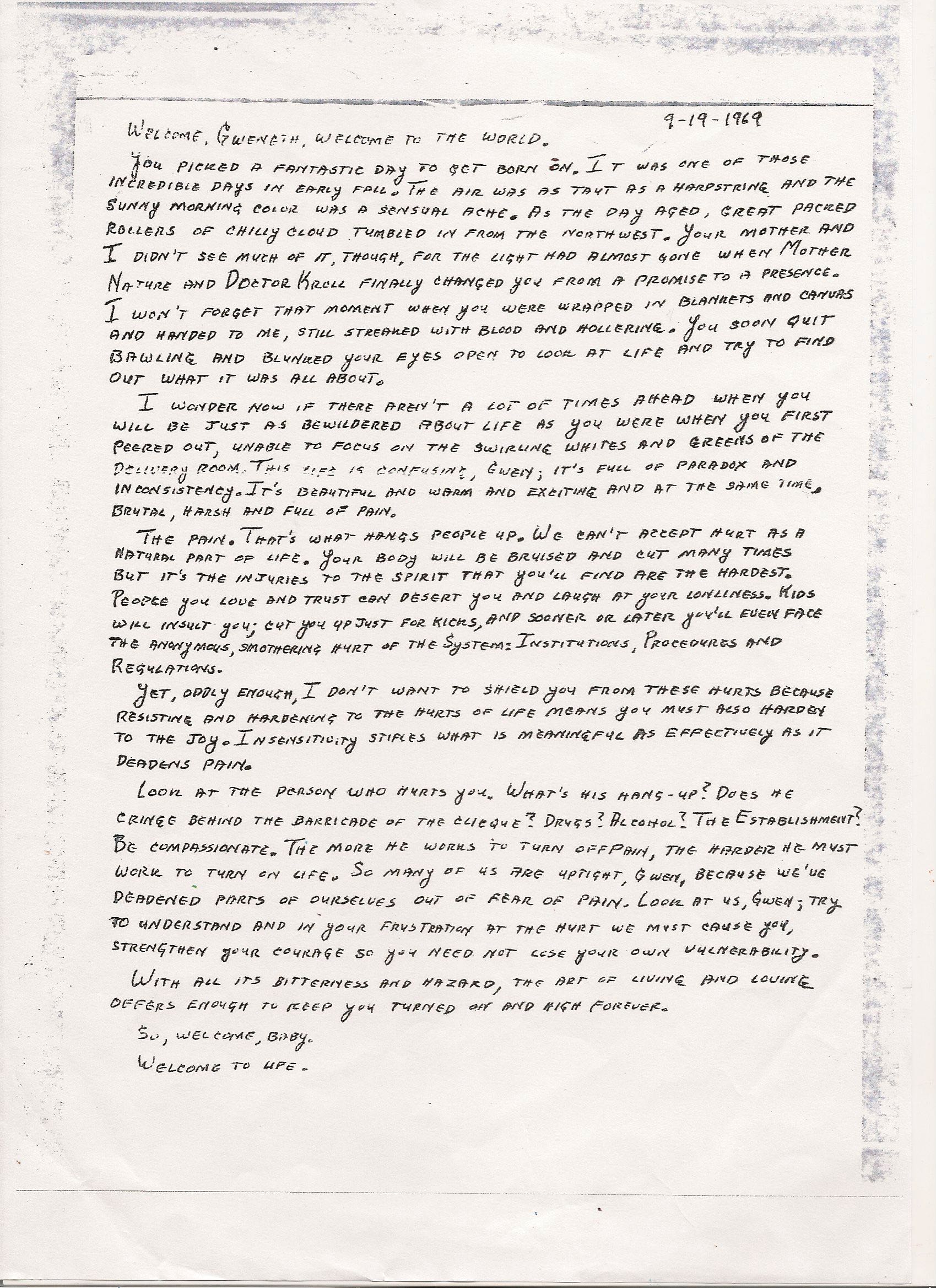
My dad died six years ago today on his 83rd birthday.  Teacher Cal, Mister B., Slim the Milkman, Cowboy Joe, Dad… he was loved by so many for his gentle presence, his musical talent and his kindness.  On the day I was born he wrote me a letter.  Thankfully I still have a copy of the letter in his distinctive block letter handwriting.  His wisdom about the world, heartbreak and all, is too good to keep to myself.  So, in tribute to him, today, I am sharing his letter with you:

“Welcome, Gweneth, Welcome to the World.

You picked a fantastic day to get born on.  It was one of those incredible days in early fall.  The air was as taut as a harp string and the sunny morning color was a sensual ache.  As the day aged, great packed rollers of chilly cloud tumbled in from the Northwest.  Your mother and I didn’t see much of it, though, for the light had almost gone when Mother Nature and Doctor Kroll finally changed you from a promise to a presence.  I won’t forget that moment when you were wrapped in blankets and canvas and handed to me, still streaked with blood and hollering.  You soon quit bawling and blinked your eyes open to look at life and try to find out what it was all about.

I wonder now if there aren’t a lot of times ahead when you will be just as bewildered about life as you were when you first peered out, unable to focus on the swirling whites and greens of the delivery room.  This life is confusing, Gwen; it’s full of paradox and inconsistency.  It’s beautiful and warm and exciting and at the same time, brutal, harsh and full of pain.

The pain.  That’s what hangs people up.  We can’t accept hurt as a natural part of life.  Your body will be bruised and cut many times but it’s the injuries to the spirit that you’ll find are the hardest.  People you love and trust can desert you and laugh at your loneliness.  Kids will insult you; cut you up just for kicks, and sooner or later you’ll even face the anonymous, smothering hurt of the system:  Institutions, Procedures and Regulations.

Yet, oddly enough, I don’t want to shield you from these hurts because resisting and hardening to the hurts of life means you must also harden to the joy.  Insensitivity stifles what is meaningful as effectively as it deadens pain.

Look a the person who hurts you.  What’s his hang-up?  Does he cringe behind the barricade of the clique?  Drugs?  Alcohol? The Establishment?  Be compassionate.  The more he works to turn off pain, the harder he must work to turn on life.  So many of us are uptight, Gwen, because we’ve deadened parts of ourselves out of fear of pain.  Look at us, Gwen; try to understand and in your frustration at the hurt we must cause you, strengthen your courage so you need not lose your own vulnerability.  With all its bitterness and hazard, the art of living and loving offers enough to keep you turned on and high forever.

So, welcome, baby.

Welcome to life.

Welcome to the World

Helping Teens Pick “Just Right Books”

My latest SCMP Between the Lines article appeared while I was out of town.  Here’s a link to the SCMP website, or the full text below:  http://www.scmp.com/lifestyle/family-education/article/1670477/young-readers-benefit-curated-selection-books

IMG_0839 IMG_0841


When children are little, part of the process of learning to read involves finding “just right books.” A just right book is one that interests a child, and that can be read fluently without struggling over more than a few words on a page. This is an important step toward reading fluency, and the process is relatively straightforward.

But once children are older finding “just right books” becomes trickier. Just because a child can read a book doesn’t mean she or he should yet. When children begin to read fluently parents often encourage more advanced books, but sometimes that can backfire, either ruining a book for a child, or exposing them inadvertently to inappropriate content.

Some parents have this idea that pushing young children into chapter books earlier and earlier makes them more accomplished or is an indicator of high intelligence. On the contrary, it’s actually robbing them of an extraordinarily rich world of content in picture books. Sophisticated parents understand that there’s a richness in picture books that doesn’t exist in the trendy, but rather straightforward popular young adult fiction. Oftentimes the language, vocabulary and humor in picture books are more subtle and advanced than in chapter books, and can help children develop critical thinking skills.

This is just another in a long line of inflationary pressure put on children. I recently spoke with a mother who told me her second grader was reading Percy Jackson to himself. An eight year old who can read Percy Jackson is superficially impressive, but how can an eight-year-old emotionally relate to a story told from the perspective of a twelve-year-old boy? What’s the point?

As children move into the teen years, finding appropriate books gets even more challenging. Because they can read everything, navigating a library or bookstore is akin to a minefield of unsuitable content. Keeping up with a voracious adolescent reader can be a full-time job.

So how do you help your burgeoning reader find the right books? Your school librarian is a great place to start. Most librarians have an extensive knowledge of and passion for books and once they get to know your child, can help match kids and with great books.

“To pick a good book you need to know your child, what mood he or she is in, his or her temperament and a wide range of books,“ says Maureen McCann, Hong Kong International School’s Middle School librarian. She suggests listening for “appeal terms” when you talk with your kids. What did they like about the last book they read? Try to determine if it’s the pacing, drama, exciting plot, or strong female character, for example, and that can help guide your next selection.

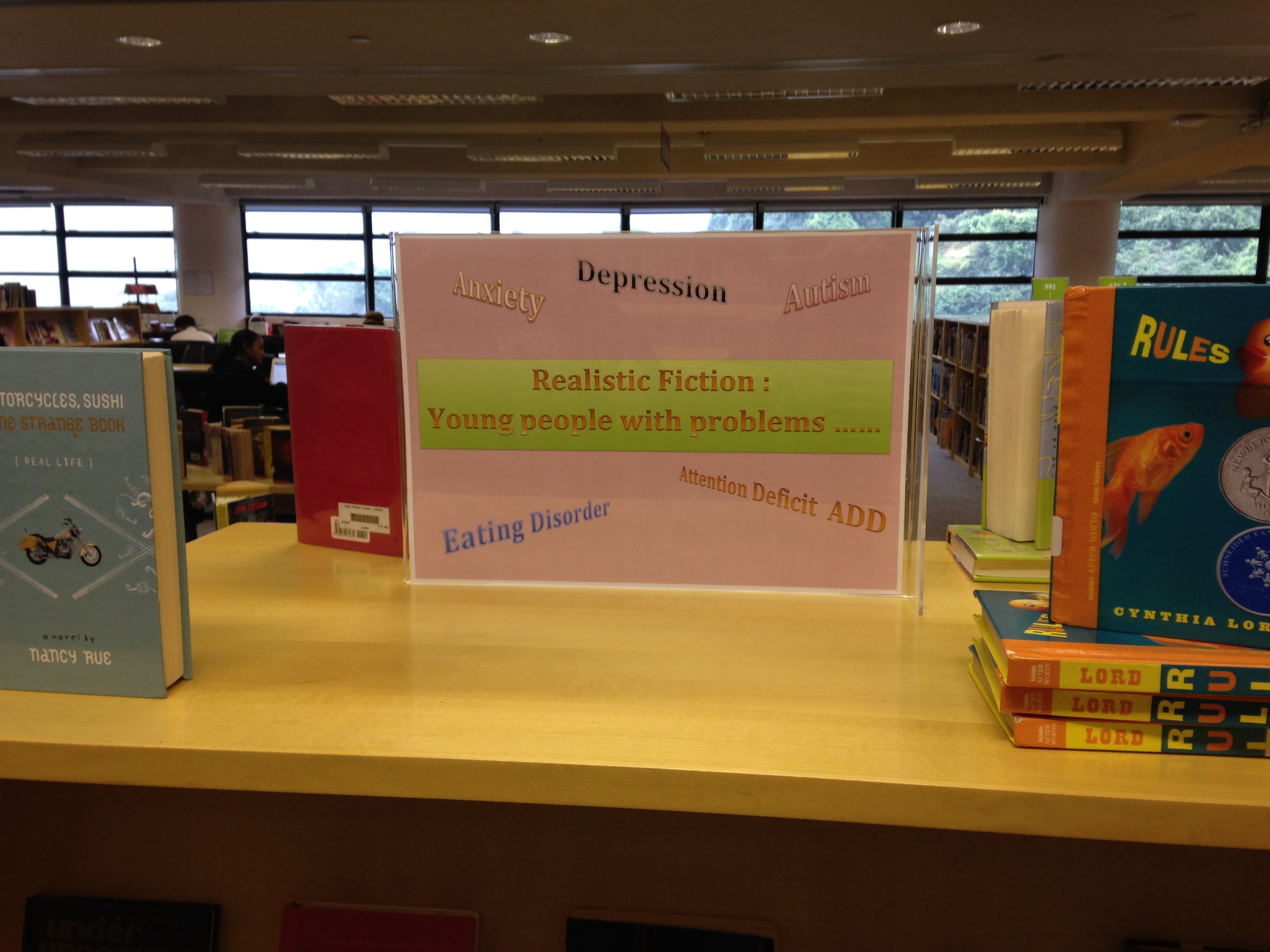
Think of your school librarian as your child’s book stylist. McCann likens book selection to buying clothing. “Everyone wants the well-edited closet. There’s an art to working a book shelf similar to a sale rack at a clothing shop.” McCann offers the library version of boutique shopping with a suggestion shelf of her favorites right in the front of the library. Some of her students select books exclusively from that shelf. Similarly, she has initiated a suggestions wall where children recommend books to their peers, and a special display for books about problems like bullying, eating disorders, divorce and other issues that teens might want to explore.

She suggests that children be allowed to browse with some autonomy. Let them discover the books on their own rather than hovering and deciding for them. She also uses a food analogy for picking books. Kids need nourishing literature and fun reads, or “snacks” – as she calls the lighter fiction books – for a healthy literary diet. Once you’ve selected a book, she suggests opening it to any page and reading a paragraph. Does it grab your attention? Do you like the character? These small investments in selecting the right book can save a lot of time in the end.

McCann also advises families to have a lot of books around the house. To be a good advisor, you have to be a good reader. You must model reading for your children, and not just on your iphone. If you’re not as familiar with a wide range of young adult literature, reading guides, essays and annotated book lists, like those by Bring Me A Book, Diane Frankenstein, Jim Trelease, and Paul Jennings for example, are great resources too.

Being a great reader is not about tackling the thickest tome you can plod your way through, but about curating your reading selections as carefully as you do your art and closet.