Bhutan Bound

Few things cause me greater discomfort than group meditation and cold, and yet in a few days I will willingly, gratefully spend 10 days fully immersed in both.  My mother was invited as a guest of the central monastic body of Bhutan to travel to the small Himalayan country, and she kindly secured an invitation for me to accompany her.  What I lack in heartiness and spiritual fortitude I hope I can make up for as the group’s chief photographer and scribe, the pragmatic optimist in a gathering of mystical heavyweights.

On the purely mundane level, I have never liked cold and since I was old enough to make my own decisions, have done my best to avoid it.  My college search revolved around temperature.  I picked Virginia because it was warmer than my home state of Pennsylvania and applied to schools exclusively in that state.  After college I moved to sub-Saharan Africa and then Los Angeles and except for two years in frigid Boston for grad school and a year in damp London, have lived in places where it doesn’t snow ever since.  My fingers go numb if it drops below 70 degrees.

My two coldest memories involve my mother, and I fear Bhutan may be the third.  I couldn’t have been more than seven when mom took me to the Poconos for a day of skiing where my loose knit mittens immediately absorbed the wet snow from my numerous falls, threatening frostbite to my little digits.  I can still recall the deep ache and tingling burn as they slowly thawed by the radiator in the nursery as she skied the rest of the day.  It took me a decade to attempt the sport again.

Years later, mom and I traveled in the dead of winter to Matinicus Island off the coast of Maine to interview year round residents for an article she was writing for the Island Institute’s periodical.  Exiting the prop plane onto the dirt airstrip on a gray, sunless January day, my lungs ached as I shallowly breathed in the biting cold air.   Our overnight hosts had a small home that was long hospitality, but short insulation.  I felt a little panicked at the idea of possibly freezing to death on that island and instinctively consumed the entire plate of hummus someone had made for the voyage, probably intuitively trying to store up some fat.

As I check the weather, Bhutan’s temperatures are scheduled to be just above freezing next week.  While East Coasters in the US are currently experiencing similar temperatures, the difference is that in New York while outside is cold, inside is heated and lovely.  From what I read, this is not the case in most places outside the fancy Aman resorts in Bhutan.  Our itinerary involves outdoor trekking to see magical, majestic sites and time spent in meditation and conversation with monks in monasteries throughout the western part of the country.  I’m taking everything warm I own and was pleased to read in the NY Times today that shivering is the body’s way of converting bad white fat into good brown fat which might help counteract my inevitable overconsumption of emadatse, the fiery hot chili cheese sauce that’s a daily staple of the Bhutanese diet.

As for group meditation, I am equally ill prepared, but well intentioned.  A birthright Quaker, 15 year practitioner of yoga, daughter of a Christian mystic, novice participant in Buddhist conferences at Hong Kong University and voracious consumer of neuroscience research, I sit at the intersection of faiths and science, a dismal practitioner of meditation, but with a deep sense of its individual and collective transformational power.  We will learn about the Mahamudra practices in Bhutan, and witness chanting and ritual as we talk with monks who have completed the 3-year/3-day/3-hour meditations at Cheri among other traditions.  If I return home with one thing from Bhutan, I hope it will be a greater patience with my own practice.  I expect to be uncomfortable most of the time I’m in Bhutan and I have to say at this point, I am totally comfortable with that.

(If you want to hear how it goes, click the link to follow this blog and stay tuned…).
Rwanda Revisited

Rwanda is an optimist’s paradise.  Naysayers and cynics move along.  This post is rife with inspiration, innovation and resilience in a country that 19 years ago was in unimaginable turmoil.

Continual controlled panic was the way I described my visit to Rwanda in October 1994, just months after a brutal genocide saw the massacre of a million people in 100 days.  On that visit I slept on the floor of the destroyed Ministry of Health office in Kibungo, eerily listening to dogs howl as they raided shallow graves for sustenance.  Tufts of hair and pools of blood still stained the floors of the new office space under consideration, and we’d speed up as we passed churches still full of the remains of those who’d fatally reasoned that the church would be a refuge rather than a mass grave during the worst of it.  I never saw a dead body that trip, but empty villages and the smell were enough to connect the dots in my imagination.  I never thought I would return.  Ever.

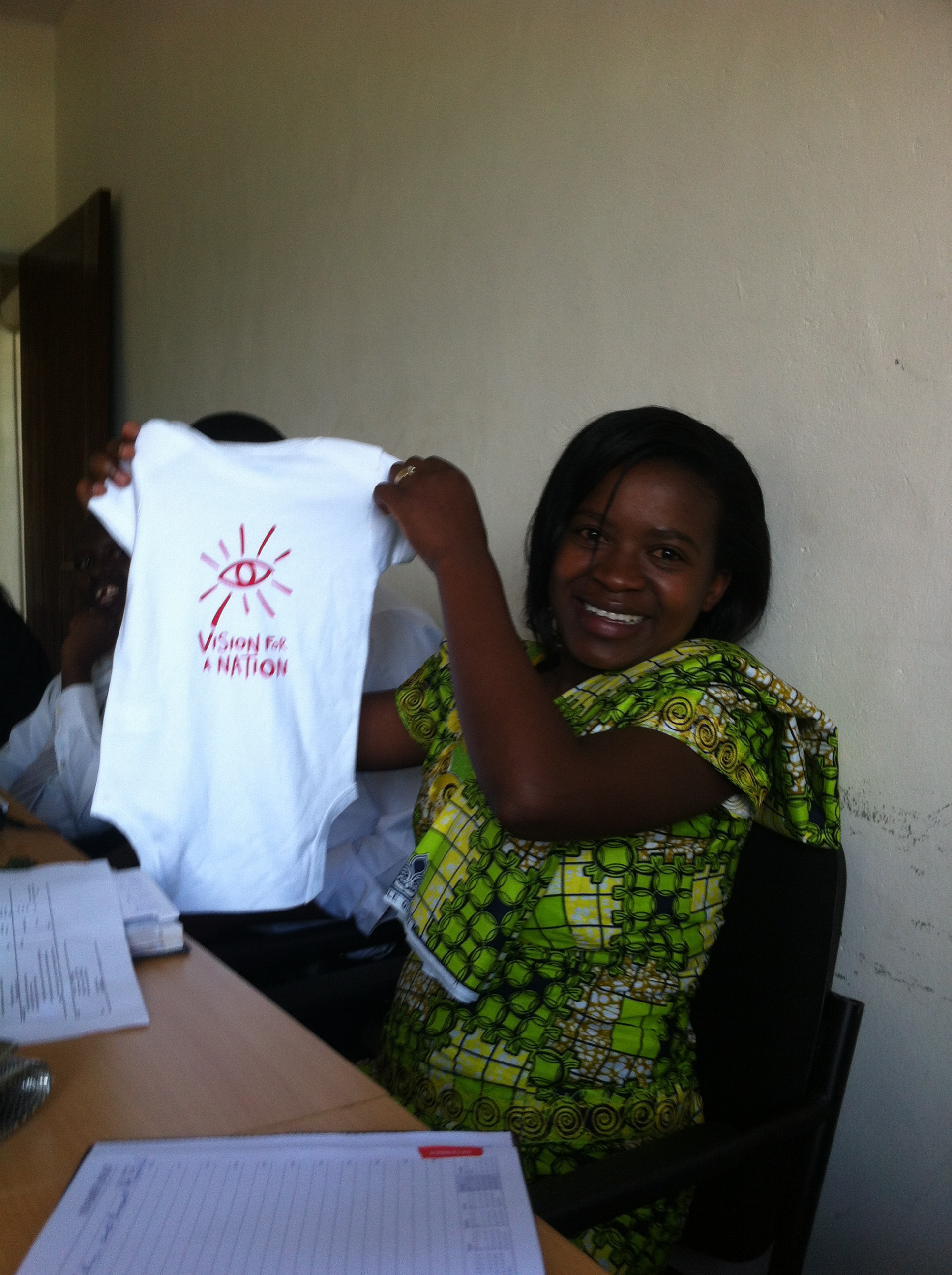
Yet last week that’s precisely what I did.  Invited as a strategic advisor to Vision for a Nation, a registered UK charity with a mission to make vision assessments and affordable eyeglasses available to all, I traveled to Rwanda and spent three remarkable days consistently impressed and inspired by what I saw and experienced.

IMG_0992

With 11 million people in Rwanda, Vision for a Nation’s goal to give every person (over 8) in the country an eye exam and provide relief for correctable refractive error is ambitious, but now that I have been there and seen their approach, I believe it is possible. VFAN was born from a simple adjustable lens technology and ‘train the trainer’ model that enables nurses to diagnose and correct refractive error in the 45 health centers throughout the country.  The adjustable glasses have dials on the sides which, when rotated, slide one lens in front of the other until the unique prescription is achieved.  Those with refractive error walk into a health center and walk out with glasses completely eliminating the need to return to the center to pick up custom glasses or the inefficiencies of pairing donated glasses from the developed world with end recipients.  It’s inexpensive, efficient and instant gratification.  Other benefits include diagnosis and treatment of cataracts, conjunctivitis and other easily treatable eye ailments.  Working in partnership with the Ministry of Health, VFAN will soon launch a public awareness campaign through a highly organized communication system in the country to educate and inform the public about vision care.  Eye care is generally not a life saving intervention, but it certainly improves quality of life.  This is one of many public health initiatives the MOH has embraced to improve the lives of those in Rwanda.

http://www.visionforanation.org

Speaking of the Ministry of Health, we were fortunate to have a private dinner with the remarkable Minister of Health, Agnes Binagwaho one night in Kigali.  The list of health initiatives she has implemented to improve the lives of Rwandans is impressive.  She is entrepreneurial, philosophical and pragmatic with a “can do” attitude I’ve never seen before in Africa.  She’s a total pro.  Dinner conversation included great one-liners like, “The best idea on the table is the one I take.”  “Money will come.  Good strategy is the important thing.”  “I want to die happy of what I have achieved.  I don’t want to be the richest in the cemetery.”   Her initiatives include the 80/40/20 plan to reduce non-communicable diseases (NCDs) by 80% for those under 40 by 2020.  To do this she began by implementing very concrete public health changes including mandating helmets for motorbikes, seatbelts, banning smoking in public places, cooking stove improvements and other initiatives that didn’t cost much, but had a huge impact.  She was the first to offer the HPV vaccine, countrywide, to schoolgirls of a certain age.  Her work in reducing HIV AIDS in the country is legendary.  Her entire staff has all gone to graduate school at the expense of the ministry and many are beginning PhDs now.  Government workers are mandated to do an exercise of their choice on Fridays during the workday and pay a fine if they do not.   She regularly tweets (as does the President) and responds to every tweet she receives.  She has 10,000 followers and has a regular Monday with the Minister show two times a month to address public health issues.  The Honorable Minister is a global health leader, not only for Rwanda.  I was honored to share a meal with her. 

Rwanda has two unique programs that contribute to its continued growth and improvement.  If I understand correctly, the Muganda is a compulsory gathering the last Saturday of every month at which time the entire country, divided into local communities, comes together to work from 7-10 on an improvement project and then from 10-12 to meet and share information.  They will paint a house that has fallen into disrepair, collect trash, build a road, or anything that the community deems as an improvement.  As a result, the country is tidy, fresh and continually improving.  Similarly, the Urunana radio programs reach an unprecedented percentage of the country with a soap opera-like ongoing storyline.  Intertwined in the programs are community health and agricultural messages.  This is one of the primary vehicles for spreading information throughout the country.  So radio that was once used for inciting violence is now used in a similar way for improving lives.

IMG_1038

Beyond health initiatives, last spring, in preparation for the TEDxHappyValley “Radical Resilience” event in Hong Kong, I was teamed up as a speech coach for a remarkable 27-year-old entrepreneur Elizabeth Dearborn Hughes, founder of the Akilah Institute for Women in Kigali.  Elizabeth taught me more than I her during the process.  When I agreed to go to Kigali, I knew that a visit to see Akilah would be important.   Akilah Institute for Women is a three-year training program for women.  Women apply, take an entrance exam, provide references and interview for spaces at Akilah.  Those selected do a foundational year of math and English language as well as leadership training and then embark on a two-year program in one of three disciplines, entrepreneurship, information management or tourism.  Women receive career counseling, do internships, and continue with leadership training and practical skills development throughout their studies.  The first graduating class in 2012 had 100% job placement.    I had the honor of having lunch with four of their current students.  I was completely inspired and humbled by their poise, intelligence, determination and vision for their futures.  I can’t say enough good things about Akilah!  If you’re looking for a good place to invest in women’s education, this would be my top recommendation.

http://www.akilahinstitute.org

Above and beyond these formal gatherings, I was inspired to meet others who are consciously building businesses in Rwanda.  A friend of a friend has launched an organic coffee farm on his family’s heritage land after having fled Rwanda in 1959.  Upon returning, he was given back his family land and is now gently learning the coffee business, producing some of the world’s finest artisenal products.  I can’t wait to try some.

A dear friend of mine, Rachel Radcliffe, made the effort to fly all the way from Nairobi to visit me during my short stay in Rwanda.  I was so touched and happy to see her!  We worked together 20 years before at OFDA and have both led circuitous international lives since then.  Reconnecting with an old friend from those formative years was grounding and inspiring.  I feel so blessed.

Returning to Rwanda under much better circumstances was cathartic.  I know it isn’t perfect.  I’ve read the articles and heard the naysayers about Rwanda, but in this post I choose to see the country as it should be, celebrating those things that are working and truly inspired by earnest, innovative efforts on the parts of so many people to make things good in a place that hasn’t always been so.

Woods or Goods?

Image

Several years ago, when my son was quite small, my mother gave me a book to read.  It sat on the shelf for a few years, unopened, and eventually I gave it away.  A few years later she gave it to me again, and again it sat on the shelf.  When we moved overseas, the book was chucked in a box and sat in a dark storage place for five years until we bought a house and liberated our treasures.  Two years ago I found the book and carried it with me all summer and back to Hong Kong, still never cracking the spine.  I had a niggling sense that this book was important, but I wasn’t ready for it until yesterday.

With deadlines for projects I’ve assumed looming, I should have taken the rare moment of quiet on a Sunday afternoon to tackle my in-box.  Instead, my children busy with their friends and my husband grouchy, I retreated to the bedroom, pulled this book from the shelf and devoted the afternoon to discovering its teachings.  The book is Bill Plotkin’s Nature and the Human Soul. Cultivating Wholeness and community in a Fragmented World.

That same evening, checking Facebook, I saw that a friend tagged me in a post linked to a new television ad for Toys R Us.  The ad depicted a busload of children on their way to a field trip in the woods who are then re-directed to the toy store instead, much to their great enthusiasm, and at the expense of a day in the forest.  Here’s the clip.

https://www.youtube.com/watch?v=lz4zqbDjYO4

I couldn’t believe the serendipity of having just read this book about how our egocentric society has gotten stuck in adolescence largely due to a lack of connection to nature.  I first re-posted the link to my own FB page with the comment, “pathetic,” but then added another post quoting directly from the book:

Stand still.   The trees ahead and the bushes beside you

Are not lost.  Wherever you are is called Here,

And you must treat it as a powerful stranger,

Must ask it permission to know it and be known.

The forest breathes.  Listen.  It answers,

I have made this place around you.

If you leave it, you may come back again, saying Here.

No two trees are the same to Raven.

No two branches are the same to Wren.

If what a tree or a bush does is lost on you,

You are surely lost.  Stand still. The forest knows

Where you are.  You must let it find you.

-David Wagoner, “Lost”

Toys R’US didn’t do anything wrong with their ad.  In fact, there’s probably not one among us who didn’t at one point during childhood fantasize about a free trip to the toy store.  They’re simply appealing to our collective voracious appetite for stuff and the delicious prospect of getting it for free.  But to have it so blatantly preferable to a day in the woods underscores that precise uncoupling of humans and nature that is as internally damaging on a personal level as it is externally to the planet.   I’m not a preachy environmentalist, but I think this book is skilled at linking a general human malaise and despondency with a very tangible explanation.

Some of my other favorite quotes so far from Nature and the Human Soul:

“If we look at the biographies of our society’s most celebrated geniuses, artists, and visionaries, we find that most of them had regular immersions in the wild, especially in childhood, and that all of them had great sensitivity to the stirrings of the soul’s deep imagination.” 

“Imagination might very well be the single most important faculty to cultivate in adolescence.  Without this cultivation, true adulthood might never be reached.” 

And my favorite quote that answers the question of an earlier post (The Wisdom of Art School)…

“I believe that most people would agree that we will not create a healthier society by affording women the equal right to be as pathologically egocentric as a large proportion of men have been for millennia, to acquire the equal opportunity to excel in the patho-adolescent, class-dividing world of prestige, position, and wealth, academic and corporate ladder-climbing, and power broking.  Rather, mature men and women must join together to foster soul centric development for both genders and for all races and cultures… 

If it’s true that…our environmental crises are due to a widespread failure of personal development, especially among the people in power in the industrialized nations (mostly wealthy males), then a radical overhaul in our way of parenting and educating children is in order.”

So, whether this post makes you want to go to Toys R Us to stock up for the holidays, or take a walk in the woods will probably explain a lot if you choose to listen.  I, for one, am going hiking…um, after I pick up a few things from the store.

RAMP… on or off, we’re still moving forward.

 Ever since I read Sheryl Sandberg’s Lean In, I have been pondering the choices I made professionally and wondering if I should have “leaned in” along the way.   I love working and I have spent most of my life preparing for and participating in the workforce, but I also love being primarily responsible for raising my kids.  What I don’t love is feeling like I have to apologize for that choice.  In a perfect scenario, I could work around my family’s needs and contribute productively to society.  This idea led me to a thought exercise that with some energy and attention, might be a first step toward more seamless transitions for men and women in and out of the workforce along a life, not just a career, path…

RAMP… On or off, we’re still moving forward.

If work life is a journey to be traveled, rather than a destination to be reached, there are bound to be stops along the way.  Think of your career as one long, fun road trip.  You travel along, at first in a stroller, upgrading to a bike, your first car, a nicer model, a sensible minivan, the midlife crisis sports car and eventually a practical Subaru (avoid the wheelchair, if possible!) and then a nice porch rocker if you’re lucky.   But on any road trip, there are pit stops, exits and entrance ramps.  These are a natural part of any trip.   When you get off the freeway for a little break, you don’t abandon your car and never look back.  Instead, you park it for a while, rest, refuel and get back on your way. Why can’t your career be like this too?

What is RAMP?

  • RAMP is a network of individuals who view their career path as a journey rather than a destination, but who recognize the need to continue to grow, whether employed or not.
  • RAMP is a social movement designed to get society to stop valuing each other by our professions, but by our intrinsic character and essential selves.
  •  RAMP is a practical resource for skills building, networking, career curation, support and advocacy.
  • RAMP is a membership-based organization, app and website that links workers with employers, or needs with skills, for project based work for individuals who are taking a break from a career, but still want to be professionally engaged.

Goal

The goal of RAMP is to become a system for aiding the off ramping and on ramping of individuals from professional career paths to family care roles and back.  The goal is nothing less than raising both society’s labor productivity and also the overall level of emotional wellness in society.  Improving social productivity in this way is an increasingly urgent economic need given aging demographics in most countries and extensive welfare spending.

Need for RAMP

Many highly skilled and educated people, predominantly women, are dropping out of the workforce in order to assume the role of primary care provider parent in their own household.  With long work hours and complicated societal demands for engaged parenting, households that can financially afford a division of labor where one is the primary bread winner and the other the primary domestic manager are feeling forced to make this difficult choice.  Increasingly this has become an all or nothing scenario, which has created an economic inefficiency that should be addressed.   Educating a sector of the population that then fails to contribute directly to the economy is time consuming, expensive and inefficient.

Beyond the economic inefficiency of educating an ultimately “non-productive” sector, choosing to leave a professional life has psychological implications that negatively impact self-esteem, divorce rates, substance abuse and so on.  The Five O-Clock glass of wine that is joked about in just about every “mommy blog” or New Yorker cartoon is actually damaging and, I theorize, a sign of deep despondency and lack of satisfaction and happiness in life.

One of the biggest things a primary care parent misses is recognition, professional growth and feedback.  Volunteering for worthy causes can help alleviate that, but for individuals to truly engage in nonprofit volunteer work they need and deserve a more formalized system of recognition and feedback that contributes to the continuity of their resumes.  This will improve the quality of the commitment volunteers make to the causes as well.

  • A  Harvard Business Review survey found that 37% of highly qualified women were “off-ramping” (voluntarily leaving their job for extended time periods) and that “three quarters [of the women surveyed] were on nonlinear career trajectories to the detriment of their earning potential and career advancement.” (HBR Magazine, June 2010).
  • With due respect to his holiness the Dali Lama who believes that happiness is the ultimate goal, we RAMPers believe that happiness is the byproduct of finding and living one’s purpose.  Viktor Frankl’s “knowing the why enables you to bear almost any how.”
  • The root of the mommy wars is not judgment of the other, but vulnerability and guilt.
  • Answering the dreaded question, “What do you DO?”

RAMP can address these issues by helping primary care parents maintain their professional skill set, sense of self worth and purpose by keeping them responsible to continually contribute to the world beyond their own families.   Rather than just drop out altogether, RAMP helps individuals create a work plan that will enable them to continue to build new skills and keep old skills fresh, and to take on projects that utilize their professional talents but still maintain schedule flexibility which is the single biggest need for primary care provider parents.

Possible components of RAMP:

1.  On-line database for skills-based project work – For people with specific skills who don’t want to work full-time, but could take on projects.  The employer doesn’t have to pay benefits and can get specialzed skills and expertise that they don’t have to have in-house without making a long-term employment contract decision.   Similar in concept to legal services firm, Axiom, individuals could even eventually work for RAMP and be hired out for projects, getting insurance and other benefits from RAMP.

2.  Political Advocacy – Want to make a real difference?  Join the RAMP Advocacy Team in being an advocate for primary care parent protection by lobbying to make changes at the government level.  Could social security benefits be shared for couples who choose to have one parent stay home to take care of children?  Paternity leave benefits?  On-site child care?  Do research and let your voice be heard to help other families navigate these important decisions better in the U.S.

3.  Networking & Community Organization – There is power in numbers.  One of the biggest concerns of stay-at-home parents is the isolation and lack of professional network they had when they “really worked.”  RAMP offers both an on-line and in-person gathering for members.  Those in the same city can meet in a common location to work together, bouncing ideas off each other and perhaps sparking innovation.  Another example would be an increased efficiency and transparency to alleviate the mommy wars.  Instead of “stay-at-home-moms” feeling put upon by working mothers who continually ask for favors without reciprocating, organize a system where stay at home moms help working moms on an up-front basis and get some kind of compensation/recognition for it rather than favors with judgment.  Mothers could join the after-school brigade coordinating carpool rides to after-school activities, hosting homework groups at their houses and so forth.  Working mothers would know that their kids were in the hands of other mothers.  Working mothers would spend RAMP stamps by the hour, while stay-at-home parents who agree to volunteer earn the stamps.  RAMP Stamps can be spent to sponsor other members, or for guidance, personal training etc.

4.  Alternate Currency – An alternate structure for RAMP might include a website/app that would match skills with needs and earn members a form of currency called RAMP Stamps.  The website would keep track of bankable hours that could be spent for other services by RAMP members.  For example:  One RAMP member is an accountant.  She is “hired” by another member to create a family budget, which takes her five hours.  She banks five RAMP Stamps.  The accountant then decides she wants a balcony garden and finds a landscape architect through RAMP to plant a garden for her, which takes four hours.  She spends four of her RAMP stamps on the garden.  The landscape architect wants to relax with a regular yoga lesson, so she finds a yoga teacher on RAMP and spends her earned RAMP stamps, one hour at a time, on yoga and so on.   The transaction requires feedback from both parties, but no cash outlay.  This gives the “employee” a professional track record that helps keep the resume current and growing even though she isn’t formally employed at the time.   It also gives the “employer” services without spending money, an issue for non-income-earning spouses.  Modeled on Paperless Post’s stamps, RAMP Stamps can also be used to sponsor other RAMP members who can’t afford the membership fees or be spent on needed services.  This will build the RAMP network along socio economic lines and encourage the spirit of RAMP in helping people help others.

Clearly this is a half baked thought exercise, not a business plan, but I wonder if it resonates with you and if you have any additional thoughts?  

Cheerleader in Africa

IMG_0420

The confluence of three seemingly disparate events last week has my mind returning to the time I spent living and working in Africa more than twenty years ago.  My book group in Hong Kong chose Aayan Hirsi Ali’s book Infidel as our first book of the season.  Ali was born the same year as I, but at Digfer Hospital in Mogadishu, the very same hospital our medical team set up shop when we arrived to help in Somalia twenty-two years later.  Our book discussion took place one evening as the stand off at the Westgate mall, just miles from my former home in Nairobi remained unresolved.  Learning that the attack was likely planned by radicalized Somalis, precisely those Ali had described in her memoir, was disheartening.  Finally, reading Kathy Eldon’s new memoir, In the Heart of Life, makes it all seem like it was yesterday.  It makes me want to share this part of the story myself…

Twenty-two years ago, a recent college graduate, I was hired to join the first American medical relief team to respond to the growing humanitarian crisis in Somalia.  Siad Barre had fled the country and clans were aligning around two main rivals, Ali Mahdi and General Aideed, vying for power in a chaotic and dangerous war.  By November our team was doing the best they could under severe conditions at Digfer Hospital in Mogadishu.  Despite our best efforts and those of a few intrepid journalists, no one was paying attention to Somalia.  By the spring of the following year, more international relief agencies had arrived and the situation had worsened as signs of famine were appearing along with the war casualties.  Jane Perlez, a New York Times reporter based in Nairobi was finally successful in placing a story, and the world began to take notice.  Seasoned Africa journalists and youthful stringers flocked to Somalia demanding international security to enable food distribution into the countryside.  Eventually, President Bush authorized U.S. intervention and some of our staff were among those Somalis waiting on the beach on December 9, 1992 when the Marines made their night landing.  The next few months were a honeymoon period as caravans of CARE’s food were escorted out to the worst hit areas like Baidoa and Belet Weyne and signs of the worst of the famine abated.  We all felt good.  Yes, there were turf battles between relief agencies, Somalis and the military, but the daily coordination meetings in Mogadishu were cordial and Operation Restore Hope was working.  I left Africa and moved to Los Angeles for a new role with the same organization, naively emboldened by a job well done.

Most people blame the turning point in public opinion of Somalia on the fateful day, October 3, known as Blackhawk Down when Somalis shot down a US helicopter and dragged a Marine through the streets.   To me, the turning point was nearly three months earlier on July 12 when an angry mob of Somalis, rightly furious at the UN for attacking a meeting of Somali elders erroneously thought to be a safe house for Aideed, turned on a group of journalists, stoning four of them to death.   My friend, twenty-two year old Dan Eldon was among those killed.  I kept working to try to help in Somalia, but the honeymoon was over.

Dan and I had bonded over dinner at the IMC compound in Baidoa one night as he teased stories of my hidden life as a high school cheerleader out of me.  He was playful, passionate and beguiling.  Both in our early twenties, the youngest expats in Somalia by at least five years, I always thought of Dan and me as the little brother & sister to the older, more experienced relief crowd.  I thought that kept us out of trouble.  One day back in Nairobi, Dan took me to lunch at the Muthaiga Club where I tasted my very first oysters.  We giggled at how the pink décor matched the ruddy cheeks of the older British expatriate crowd. After lunch Dan darted out for an appointment at Nairobi hospital where he had arranged to x-ray the posterior of a Kenyan woman who could move her hips in a way he’d never seen before.  He wanted to know if she was physiologically different from other people.   Dan was curious about everything, afraid of nothing and genuinely interested in everyone’s story.

Years later, still living in Los Angeles, I attended a book signing by author, former Reuters reporter and dear friend of Dan’s, Aidan Hartley.  As he spoke about his book, Zanzibar Chest, he gave credit to international journalists for having roused public attention to Somalia.  Then he proceeded to talk about how the international community had royally screwed it all up.  He remains among the most critical of international intervention in Somalia today and one of the few who is still paying attention.  Later that night over drinks with some friends I asked Aidan, given how it all turned out, would he still have done the same thing?  He didn’t say so directly, but I suspect not.

That’s the fundamental question we all face.  Knowing that humanitarian intervention is imperfect, that unintended consequences of well-intended efforts can often make things worse, and that donating to a relief organization feels like renting instead of buying your home, whereby the immediate benefit is clear, but over the long term you feel like you’re throwing money away.  Still, what’s the alternative?  It is easy for journalists to criticize interventions without offering a solution and for those of us who see the system as flawed to armchair quarterback and keep our money in the bank.  I applaud the imperfect interventions by those still drawn to do something, even as I yearn for a different model altogether.

This week Dan’s mother, Kathy Eldon, published her own memoir, In the Heart of Life, as a way to share her journey from grief to creative activism in Dan’s memory.  The launch of her story of hopefulness and resilience poignantly coincides with the horrific attack at the Westgate shopping center last week, only miles from Dan’s childhood home in Nairobi.  While Kathy has spent the intervening twenty years since Dan’s tragic death methodically rebuilding her life in a vision of engagement and hope for the future, Somalia sinks deeper into a twenty-five year spiral of turmoil and despair, continued violence and destruction.  It makes me wonder if Kathy’s Creative Visions Foundation approach, one that works to engage youth just like those Ali describes in her memoir and the nightly news describes at the Westgate mall, might just be Dan’s greatest life’s work?