The Snail

This morning I put the kids on the bus and headed out for a run along the South China Sea. Listening to Krista Tippett interview Paul Elie about Thomas Merton, Dorothy Day, Flannery O’Connor and Walker Percy on her radio show On Being, I settled into an easy pace and listened. Of these 20th century writers Elie said, “They weren’t content to settle in that place and say, ‘This is my lot,’ or ‘This is the lot of our time.’ Their hunger for something more, for something deeper was so strong that they made that unbelief or disbelief a starting point and then a continual testing ground for their religious convictions.”

As I listened to the interview, I ran along Stanley Main Beach, through town and up over Chung Hom Kok Road. Turning into Ma Hang Park on my return I noticed a woman standing in the middle of the path ahead of me. Something held her attention, and I wondered what it was.  Getting closer, I saw that the woman was a friend of mine and the object of her attention was a large garden slug with a shell on its back that had made its way all the way to the end of a long, dangling palm. The palm hung from a towering tree, but stopped short a good three feet above the concrete path. We stopped and stared wondering where the snail would go from there. It seemed to be in the most impossible predicament. Could a snail that size turn around? Could it back up? Would it linger until it ran out of food, water and strength then release and fall to the path below, surely cracking its shell? Had the snail unwittingly crept to a certain death, or was there a way out that we couldn’t see?

My friend was out for a walk. Her in-laws are visiting and, it being Monday morning, she subtly suggested that her walk was precipitated by a need for a little alone time after a weekend of togetherness. I bid her a cheerful farewell and started again on my run, but then stopped and called out to her.

“Monique! I love that you stopped to look at that snail. Keep that in mind today and remember, it doesn’t get worse than that!”

We both smiled and went our separate ways. As I turned back to my podcast, Paul Elie was quoting Walker Percy. “The pilgrim’s search is outside oneself. The Guru searches within.” I thought this delightfully fitting apropos the poor snail’s predicament and my friend’s momentary escape. Were any of us this morning content with “this is my lot” or did we hunger for more? Were the snail’s survival resources to be found within or outside itself?

I think I will return this afternoon to see if the snail remains on the palm or if the snail’s remains mark the pavement below. If it’s still hanging on, I may just give it a lift to lower ground. Perhaps, as I think about it now, I should have done that in the first place. But then how can it be that a snail would need me to save it?


Dharma Diet: The Rise of Secular Mindfulness

The diet industry and the burgeoning popularity of secular mindfulness have a lot in common I realized as I sat listening to the distinguished panel at the Mind & Life Institute conference at Hong Kong University last fall. Growth of the mindfulness industry in the last decade has been meteoric and is as unruly as is the diet industry, and subject to the same vulnerabilities. Like dieting, the desired outcome of mindfulness efforts is evident, but for most of us, the path is unclear.

We have accepted a huge “mindfulness” umbrella that houses everything from deeply spiritual monks who relinquish everything to sit for years in silent solitude in mediation and prayer to completely secular deep breathing exercises used to help modern day stress cases function better in their stressful environments. The comingling of untrained “experts” and revered practitioners in one big pot of mindfulness soup makes it difficult for the layman to figure out what is solid research and what is just clever marketing.

Mindfulness is the latest panacea. If you haven’t read of the benefits of a mindfulness practice, you must have been living under a rock. Compassion, stress relief, mental acuity and memory, health, your emotional style, relationships and more can all be enhanced with a simple daily practice.   Add deep breathing exercises to your to do list and you’re bound for greatness, in just six weeks!

When scientists like Dr. Richard Davidson, Dr. Mark Williams, Dr. Rick Hanson and others share quantitative research indicating actual brain changes as a result of meditation, I am curious to know if all meditation practices are created equal, or if the specific benefits they claim are the result of a particular form of practice. When I asked the question at the conference, Dr. Davidson glibly replied, “The one that you’ll do is the one that works“ suggesting that sticking to it is more important than the practice itself.  Sound familiar?

Twenty years ago I was nearly 40 pounds overweight. I remember standing in front of a mirror squeezing the fat rolls on my stomach and making deals with God. If I could just be thin and have a flat stomach, I would be happy. I tried dieting, depriving myself of the foods that I loved, restricting calories, but the moment-to-moment willpower required to achieve the overall goal was never strong enough and I felt like a failure.

Beyond the “freshman 15”, mine was a mixed up combination of emotional overeating to combat the starvation I witnessed in Somalia and downright gluttonous expat living in Nairobi.   From Africa I moved to Los Angeles where my lifestyle changed organically. I started running after work because it was so beautiful outside. My first run was 11 minutes long, but I eventually worked up to 30, then 45 and then amazingly an hour. I consciously cut out beer, but otherwise I ate the foods I wanted. As I began to run more, the foods I craved changed. I still had the diet coke and Twix bar after lunch (a disgusting habit of the late ‘90s I still can’t believe I did), but I had them after a salad instead of a burger and fries, and eventually they dropped out too in favor of water and a home made cookie (still my favorite). That was 20 years ago. Since then I have had three babies, gained and lost 60 pounds with each pregnancy, and my weight is not currently a struggle.

What finally worked for me was letting go of the goal in favor of small daily changes that eventually, almost without my noticing, achieved the results I had nearly forgotten I wanted. What I learned is that most diets don’t work because they’re tied to outcome.

I agree with Dr. Davidson, that to achieve the benefits of meditation you must actually meditate, but by defining the benefits by a set of outcomes, we’re missing the point and actually adding stress to our over burdened lives and never-ending to do lists. What if we forgot about the benefits for a moment and remember where these practices come from in the first place? What if we were actually motivated intrinsically, instead of for superficial external reward?  Let’s take a lesson from the largely failed diet industry and try instead to pay attention to deep yearnings in our souls for more meaningful lives. When motivated from this place, from a conscious decision to capture and defend those unplugged quiet moments without distraction, the benefits of a mindfulness practice will flow naturally and the minutes on the meditation cushion will melt away as easily as the unwanted pounds.

What do you like to do?

I keep thinking about Sheryl Sandberg’s book Lean In.  While I agree with a lot of what she said, my prevailing reaction remains, “Yes, but so what?”  A ‘Free to Be You and Me’-loving slow reader with an ambitious nightstand stack who turns the corners of her books and still likes paper to do lists is my kind of expert.  Yet, while I relate to Sandberg on some levels, appreciate her candor and don’t take issue with most of her book, I think she’s missing the point.  She is providing reasonable advice for an old paradigm.  “Leaning in” or “reclining” as a recent NY Times OpEd encouraged doesn’t really matter because it doesn’t address the fundamental societal problem we all face.  Until men and women alike stop defining ourselves and each other by what we do for a living, there will be no effective progress toward mitigating an existential crisis masquerading as a business problem.    

The limiting factor in the whole debate — the mommy wars, breaking glass ceilings, affirmative action, helicopter parenting and the crisis in education to name a few — centers around our insistence upon evaluating and judging our worth and that of others by our jobs and professions.  Yes, knowing what someone does gives an easy line of questioning and a relational hook, but usually limits the conversation to a superficial level.  Some people are lucky to find a career that enables them to live their purpose, where work and life are so seamless that there is no difference between ‘who they are’ and ‘what they do.’ But for most people, the job is a means to support a life and is only one aspect of what makes that person interesting and worthwhile. 

For ‘stay-at-home’ mothers, particularly those who are well-educated and previously on ambitious career tracks but choose to take some time off to enjoy their kids and support their families, one of the least expected but hardest elements is that people stop asking you questions.  People don’t know what you know about, so they don’t know what to ask.  That, or they smile, pat you on the shoulder and say “You have the hardest job in the world.” Nothing fuels the mommy wars more than this patronizing sentence.  

Getting to know a person for who they are instead of what they do takes work, but here’s a suggestion for how to start.   This is the first blog post I ever wrote, but without naming the players.  In this context, I share this experience again in hopes of adding a lot more likes to the conversation.  Please try this one time this week and see what happens:

I will forever have a special place in my heart for Chris Martin, lead singer of Coldplay and husband of Gwyneth Paltrow, but not for the reason you might think.  Sure he’s a great musician, but it is the lesson he taught me with one little word that will indelibly link him in my mind to gracefulness.

I met Gwyneth through my mother who is a Christian mystic and contributor to Gwyneth’s website GOOP.  She kindly invited me to her home a few times and on one particular afternoon, Chris happened to be there too.  Having been forewarned that he was on voice rest after completing his latest album so I shouldn’t expect him to say much, I was surprised when he sat down to lunch in his backyard, turned to me and asked,

“What do you LIKE to do?” 

With the addition of that one simple word, “LIKE” — a word I’m usually trying to erase from my family’s California born and bred vocabulary — he so chivalrously lay down his cloak, welcoming me to step daintily across that first impression hurdle.  With that one word the possibilities were opened and Chris got a real answer.  

“Well,” I gulped.  I decided to go for it. 

“I like to take my children on adventures to exotic places near our adopted home in Hong Kong.  I like to cook and have friends over to enjoy it with me.  I like to run, hike and do yoga.  I like to write, but I’m not as good at it as I’d like.  I like to read, travel, organize things, explore and most of all, to stay connected to my good friends.” 

“What kind of yoga do you do?  Because your arms are very fit,” he replied.  I liked that question too.

With that one word, he spared me that awful other question that stay-at-home moms have not yet figured out how to answer with the force and authority we used to be able to muster when we “really worked.” Had he asked me, “What do you do?” my answer would have been an apologetic jumble of volunteer parent advisory groups, girl scouts, glorified travel agent and bus driver for my family, that trailed off with, “You, know, that kind of stuff.” Just think for a moment how much better his question is, and what a difference it could make if we all added “LIKE” to our vocabulary in the right places. 

And, it was a good thing he had built up some good will with that question, because I had a bit more trouble answering his next one.

“Are all bankers assholes?” he asked. 

“Well,” I gulped. 

Tashi Delek – A Journey to Bhutan, Part IV, Homeward Bound

Retracing our steps, working our way back to Paro over the course of the next three days, we had a chance to shop, check our email, reflect and regroup in now familiar Thimpu.  Our official meetings were finished, but there was still work to be done.

P1040088P1040093

The drive back between Punakha and Thimpu could not have been more different from our previous summit days before.  This time the sky was blue and, as we reached Dochula we had a 360 degree view of the Himalayas all around us.  As we waited for the pass to open, we explored the 108 chortens build by the Queen mother commemorating those lost in a brief skirmish with India in 2003 as well as the temple built in honor of the 4th Druk Gyalpo which contained paintings by Karma Ura.

P1040135

Returning to where it all began outside Paro, on our last day we climbed to Tiger’s Nest.  At my regular pace it would have taken about an hour, but for our group it took three.  Slowly we ascended, savoring the now comfortable conversation as much as the view.  I worked consciously not to make the destination the whole goal as we meandered our way up, catching glimpses of Takshang on a competing peak across the deep divide.  After finally reaching Takshang’s elevation, the path turns toward the mountain face and one must descend hundreds of steps only to climb back up to the final destination perched impossibly on the cliff above.

P1040141

Dedicated to Guru Padmasambhava Rimpoche the tantric mystic who brought Buddhism to Bhutan and who flew on a tigress and landed on that sacred spot that is said to resemble a dagger, Takshang defies all reason.   To build the foundation, Regent Tenzin Rabgye mixed hair with flour and water and tossed it out.  Where it stuck, they placed small stones, then larger and larger stones on top until the foundation emerged.  Despite two significant fires in the 20th century that destroyed documents and most of the temples, the foundation and the statue of Guru Padmasambhava Rimpoche survived unharmed.  Taksang was rebuilt upon the original foundation.

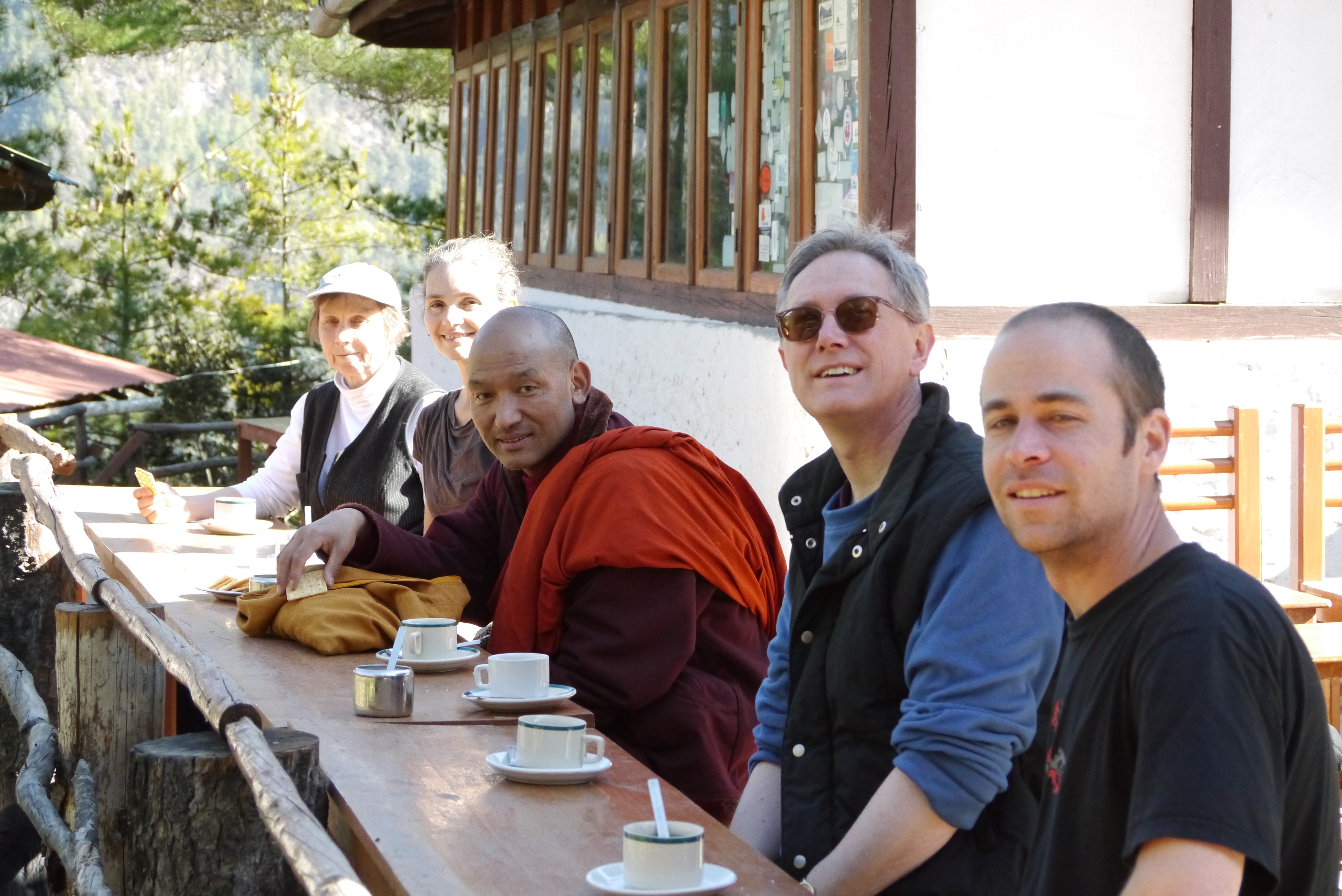
Inside Taksang, the new Abbot welcomed and served us tea and biscuits before giving us a personal tour of several of the 11 temples, two of which are closed to outsiders because visitors might bring bad omens and cause harm.  The primary temple is built around an auspicious and powerful cave that is accessible only to the most senior of monks and only at certain times of the year.  The rest of the time an imposing face festooned with offerings blocks the entrance.  In this temple, those who have powers charge the place while others receive. We sat before the statue in a light filled temple as many, many pilgrims, including a beautiful young boy with glasses in a gold gho earnestly worshiped.

P1040157

The descent was much faster, even with a quick stop for tea along the way, and we got to the bottom to find Namgyel, back from a quick trip to India, waiting.  It was like greeting an old friend.  He drove us back to the guesthouse where we had our final meal together and then Gembo offered his final surprise, a culture show.  Performers in elaborate costumes shared cultural heritage through song and dance and even got us up dancing.

P1040164

After the show, our group attempted a wrap up session, but it was the least successful initiative we undertook on the trip.  Too many emotions, thoughts, ideas, feelings swirled and the energy was too solemn.   Overwhelming gratitude to our hosts clouded our ability to rationally analyze the important elements of the trip and to lighten up and just talk.  At least that’s how I felt.  We said goodnight and turned our attention to the mundane tasks of packing for our departure, reasoning that for a reflective bunch such as us, the meaning would reveal when it did.

Despite continual togetherness for eleven days, we never really established the true impetus for the generous invitation and treatment we received on this journey.  Gembo told us on our first night together that learning other traditions equips you with a way to see your own culture.  That Bhutan has the desire to slow down the process of modernization and to maintain the culture, tradition, way of living and whatever is possible of the values and the goodness that Bhutan has as it modernizes. To do so well, they need right intervention and good decisions in their leadership.  Values must be in the heart of any good decision maker.  A perpetual student and curious to a fault, Gembo reasoned that experienced teachers of Christianity can link values and teach as well as learn from each other so as to eventually walk on same path, aligned.

Gembo, Sabina and Namgyel took us to the airport the following morning.  We bid farewell with promises to keep in touch, hearts heavy with gratitude for the experience of a lifetime.  While we all went to Bhutan for our own reasons, collectively something big happened.   The group is just now getting around to putting thoughts on paper in a much more reflective way than mine.

Returning to the beginning of the journey, I can only offer that the essence of an artichoke is its heart, and is fiercely protected.  It isn’t immediately obvious and takes hard work to reach.  Whoever was the first to discover the sweet reward of an artichoke must have been wise and persistent; patient, purposeful and resolute.  All qualities I hope I gained a little on this journey.  The deepest and most profound moments and stories of our trip are like that artichoke, protected, and hidden deep within…for now.  I will write them, maybe for a book one day and only at the grace and agreement of those involved.  For now I hope that these tales give you some of those tasty morsels on the outside and a desire to dig deeper with me, eventually, to the heart.

To Gembo and Sabina, all I can say is “Name same kadin chhe.”  Thank you beyond the sky and earth.

Image

“Tiger Mother” or “Panda Mom,” they both face extinction.

Re-posting in recognition of International Women’s Day today.

gwenborg's avatar

I wrote this a few years ago as the Tiger Mother phenomenon was raging.  It still reflects my thoughts on parenting:

As an American woman living in Hong Kong, so far away from family and friends, I rely on Facebook not only as a way to keep in touch, but as a pulse point for news.  You would have thought that a revolution had started when I turned on my computer to find no fewer that a dozen friends had posted links to a Wall Street Journal article entitled, “Why Chinese Mothers are Superior” by Amy Chua.   While Ms. Chua makes a very strong case for the Tiger Mother that I must admit did explain some play date behavior and made the hairs on my neck bristle at the “everybody gets a trophy” liberal parenting camp, the pressure cooker approach she espouses is bound to blow.

A wise friend in…

View original post 1,021 more words