Bhutan Bound

Few things cause me greater discomfort than group meditation and cold, and yet in a few days I will willingly, gratefully spend 10 days fully immersed in both.  My mother was invited as a guest of the central monastic body of Bhutan to travel to the small Himalayan country, and she kindly secured an invitation for me to accompany her.  What I lack in heartiness and spiritual fortitude I hope I can make up for as the group’s chief photographer and scribe, the pragmatic optimist in a gathering of mystical heavyweights.

On the purely mundane level, I have never liked cold and since I was old enough to make my own decisions, have done my best to avoid it.  My college search revolved around temperature.  I picked Virginia because it was warmer than my home state of Pennsylvania and applied to schools exclusively in that state.  After college I moved to sub-Saharan Africa and then Los Angeles and except for two years in frigid Boston for grad school and a year in damp London, have lived in places where it doesn’t snow ever since.  My fingers go numb if it drops below 70 degrees.

My two coldest memories involve my mother, and I fear Bhutan may be the third.  I couldn’t have been more than seven when mom took me to the Poconos for a day of skiing where my loose knit mittens immediately absorbed the wet snow from my numerous falls, threatening frostbite to my little digits.  I can still recall the deep ache and tingling burn as they slowly thawed by the radiator in the nursery as she skied the rest of the day.  It took me a decade to attempt the sport again.

Years later, mom and I traveled in the dead of winter to Matinicus Island off the coast of Maine to interview year round residents for an article she was writing for the Island Institute’s periodical.  Exiting the prop plane onto the dirt airstrip on a gray, sunless January day, my lungs ached as I shallowly breathed in the biting cold air.   Our overnight hosts had a small home that was long hospitality, but short insulation.  I felt a little panicked at the idea of possibly freezing to death on that island and instinctively consumed the entire plate of hummus someone had made for the voyage, probably intuitively trying to store up some fat.

As I check the weather, Bhutan’s temperatures are scheduled to be just above freezing next week.  While East Coasters in the US are currently experiencing similar temperatures, the difference is that in New York while outside is cold, inside is heated and lovely.  From what I read, this is not the case in most places outside the fancy Aman resorts in Bhutan.  Our itinerary involves outdoor trekking to see magical, majestic sites and time spent in meditation and conversation with monks in monasteries throughout the western part of the country.  I’m taking everything warm I own and was pleased to read in the NY Times today that shivering is the body’s way of converting bad white fat into good brown fat which might help counteract my inevitable overconsumption of emadatse, the fiery hot chili cheese sauce that’s a daily staple of the Bhutanese diet.

As for group meditation, I am equally ill prepared, but well intentioned.  A birthright Quaker, 15 year practitioner of yoga, daughter of a Christian mystic, novice participant in Buddhist conferences at Hong Kong University and voracious consumer of neuroscience research, I sit at the intersection of faiths and science, a dismal practitioner of meditation, but with a deep sense of its individual and collective transformational power.  We will learn about the Mahamudra practices in Bhutan, and witness chanting and ritual as we talk with monks who have completed the 3-year/3-day/3-hour meditations at Cheri among other traditions.  If I return home with one thing from Bhutan, I hope it will be a greater patience with my own practice.  I expect to be uncomfortable most of the time I’m in Bhutan and I have to say at this point, I am totally comfortable with that.

(If you want to hear how it goes, click the link to follow this blog and stay tuned…).

Stop Calling Her A Socialite

The woman who fell to her death from the roof of a building in Beverly Hills last week was an artist, a mother, a wife, a successful businesswoman, and a humanitarian.  She co-founded Child Welfare Scheme Hong Kong, a nonprofit organization dedicated to helping children in Nepal.  She designed and sold exquisite one-of-a-kind jewelry in the finest boutiques around the world.   She catalyzed a donation drive raising extraordinary amounts of money and goods in the wake of the recent hurricane in the Philippines.  She hosted a female Tibetan Buddhist Lama in her home and had a private audience with his holiness the Dali Lama. She has contributed wisdom, expertise and resources to dozens of local and global organizations and worked tirelessly to create a beautiful, conscious life for her family, her community, and the world.  Call her any of these things, but please don’t call her a socialite.  She was anything but.   

Sandra d’Auriol’s death last week is a tragedy by any measure, but the media’s insistence on headlining news calling her a socialite just because her family was well-resourced shows an appalling lack of respect for the extraordinary contributions she made to the world.   While the reason for her death may never be fully understood, the most likely scenario is an adverse reaction to prolonged exposure to anesthesia for an unbelievable 13 straight hours combined with copious pain medication.  This drug cocktail could be a shock to anyone’s system, but especially so for one who lived a healthy life, steering clear of medications and chemicals as much as possible.

I have no defense of her decision to seek cosmetic surgery.  She radiated beauty and had no need for such a procedure.  But you know full well that the pressure on women to forestall the aging process at all costs is real and the results can sometimes be devastating.  Even my own dear friend offering helpful advice as I casually lamented the growing crease on my forehead texted, “a little filler and some botox and you’ll be fine” as if she’d just suggested I put on some lip gloss.  She totally meant well, and she’s right, I would probably look younger if I added a little filler and botox to my face, but where’s the line and how do you know when you’ve crossed it?

Sandra sent an email to her friends on January 10, 2014, not two weeks before she died.  If you have any lingering suspicion about her engagement in life and love for it, this should clear it.  Here is what she said:

Dear Friends,

First of all to wish you a wonderful New Year, Happiness, Health, Success and the time to enjoy it all!

As you know all the proceeds from my business go to helping different humanitarian and environmental projects each year.

I thought it would be nice for you to know who your support has benefited, it makes the circle of buying gifts from me so much more meaningful.

Financial Donations:

Plastic Oceans Foundation

Senior Citizen Home Safety Association

Child Welfare Scheme Ltd

Kids4Kids Ltd

Clean Air Network

Society for Promotion of Hospice Care

Art in Hospital Ltd

Bloom Association

UNHCR

Lam Tin Qi Gong Project

Burning Clinic in Nepal

Avaaz Foundation

Joshua Hellmann Foundation

Environmental Working Group

Samasound Association

Avaaz Foundation

Wikimedia

Al-Seeraj

OXFAM

Pat Liang (Cell Phone for Philippine Relief)

2 Laptops for Khandro Thrinlay Chodon

Project Aware Australia

Go Fund Me

Angki Purbandono

Donations of Goods for Auction Items:

Orange County School of Arts

Chi Fan

HKSF

Child Welfare Scheme

Passerelles Numeriques

Mother’s Choice

Thank you so much for your continued support, and a special thank you to my husband who makes this all possible!

With best wishes

Sandra

If that is the definition of a socialite, then sign me up.  If not, then please honor her memory by googling the charities she supported and making a contribution in her name and by calling her what she was; a remarkable woman.

Here’s one to get you started:    http://www.cwshk.org

Sandra_reminder 13_v2-01

Rwanda Revisited

Rwanda is an optimist’s paradise.  Naysayers and cynics move along.  This post is rife with inspiration, innovation and resilience in a country that 19 years ago was in unimaginable turmoil.

Continual controlled panic was the way I described my visit to Rwanda in October 1994, just months after a brutal genocide saw the massacre of a million people in 100 days.  On that visit I slept on the floor of the destroyed Ministry of Health office in Kibungo, eerily listening to dogs howl as they raided shallow graves for sustenance.  Tufts of hair and pools of blood still stained the floors of the new office space under consideration, and we’d speed up as we passed churches still full of the remains of those who’d fatally reasoned that the church would be a refuge rather than a mass grave during the worst of it.  I never saw a dead body that trip, but empty villages and the smell were enough to connect the dots in my imagination.  I never thought I would return.  Ever.

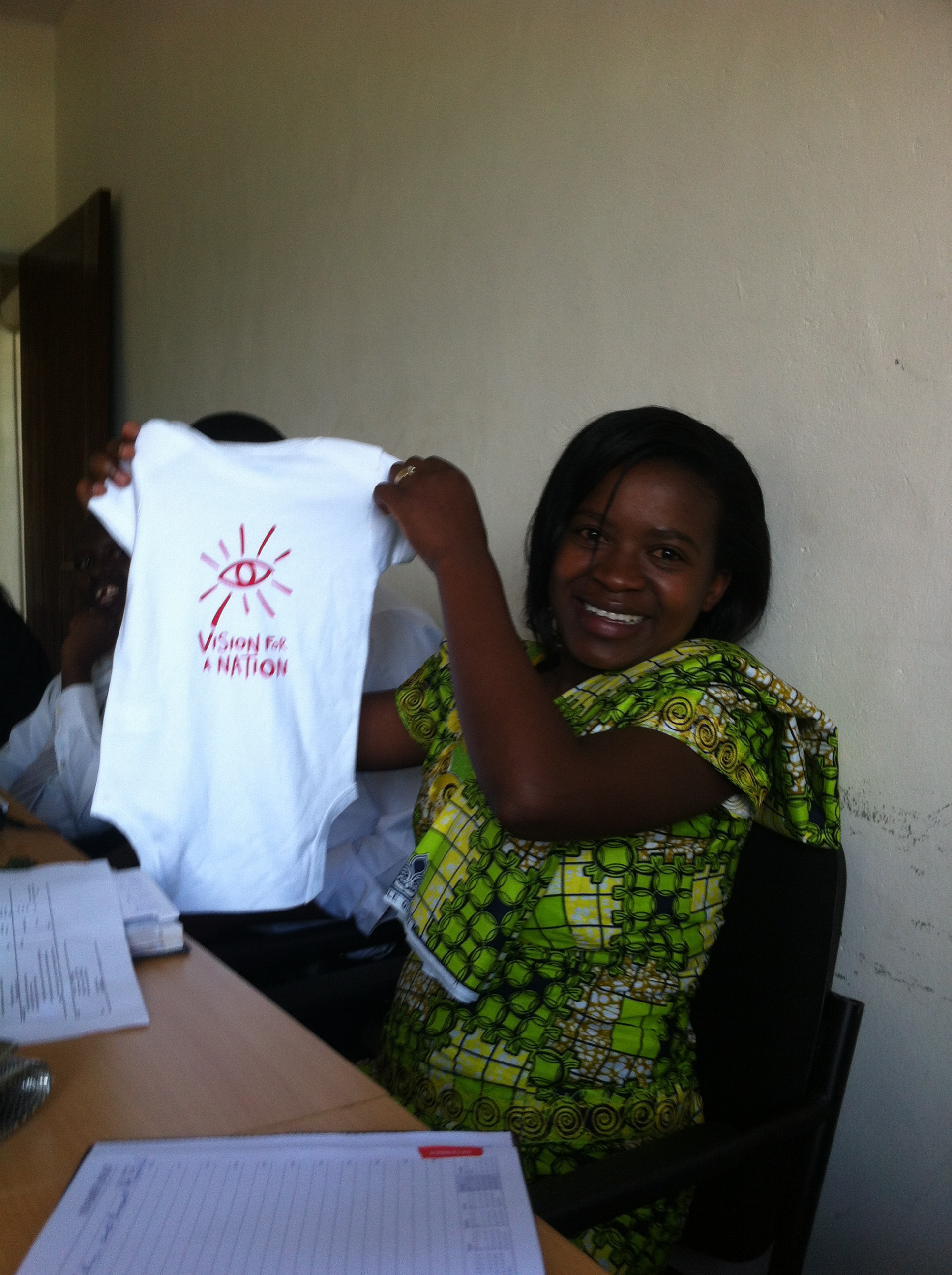
Yet last week that’s precisely what I did.  Invited as a strategic advisor to Vision for a Nation, a registered UK charity with a mission to make vision assessments and affordable eyeglasses available to all, I traveled to Rwanda and spent three remarkable days consistently impressed and inspired by what I saw and experienced.

IMG_0992

With 11 million people in Rwanda, Vision for a Nation’s goal to give every person (over 8) in the country an eye exam and provide relief for correctable refractive error is ambitious, but now that I have been there and seen their approach, I believe it is possible. VFAN was born from a simple adjustable lens technology and ‘train the trainer’ model that enables nurses to diagnose and correct refractive error in the 45 health centers throughout the country.  The adjustable glasses have dials on the sides which, when rotated, slide one lens in front of the other until the unique prescription is achieved.  Those with refractive error walk into a health center and walk out with glasses completely eliminating the need to return to the center to pick up custom glasses or the inefficiencies of pairing donated glasses from the developed world with end recipients.  It’s inexpensive, efficient and instant gratification.  Other benefits include diagnosis and treatment of cataracts, conjunctivitis and other easily treatable eye ailments.  Working in partnership with the Ministry of Health, VFAN will soon launch a public awareness campaign through a highly organized communication system in the country to educate and inform the public about vision care.  Eye care is generally not a life saving intervention, but it certainly improves quality of life.  This is one of many public health initiatives the MOH has embraced to improve the lives of those in Rwanda.

http://www.visionforanation.org

Speaking of the Ministry of Health, we were fortunate to have a private dinner with the remarkable Minister of Health, Agnes Binagwaho one night in Kigali.  The list of health initiatives she has implemented to improve the lives of Rwandans is impressive.  She is entrepreneurial, philosophical and pragmatic with a “can do” attitude I’ve never seen before in Africa.  She’s a total pro.  Dinner conversation included great one-liners like, “The best idea on the table is the one I take.”  “Money will come.  Good strategy is the important thing.”  “I want to die happy of what I have achieved.  I don’t want to be the richest in the cemetery.”   Her initiatives include the 80/40/20 plan to reduce non-communicable diseases (NCDs) by 80% for those under 40 by 2020.  To do this she began by implementing very concrete public health changes including mandating helmets for motorbikes, seatbelts, banning smoking in public places, cooking stove improvements and other initiatives that didn’t cost much, but had a huge impact.  She was the first to offer the HPV vaccine, countrywide, to schoolgirls of a certain age.  Her work in reducing HIV AIDS in the country is legendary.  Her entire staff has all gone to graduate school at the expense of the ministry and many are beginning PhDs now.  Government workers are mandated to do an exercise of their choice on Fridays during the workday and pay a fine if they do not.   She regularly tweets (as does the President) and responds to every tweet she receives.  She has 10,000 followers and has a regular Monday with the Minister show two times a month to address public health issues.  The Honorable Minister is a global health leader, not only for Rwanda.  I was honored to share a meal with her. 

Rwanda has two unique programs that contribute to its continued growth and improvement.  If I understand correctly, the Muganda is a compulsory gathering the last Saturday of every month at which time the entire country, divided into local communities, comes together to work from 7-10 on an improvement project and then from 10-12 to meet and share information.  They will paint a house that has fallen into disrepair, collect trash, build a road, or anything that the community deems as an improvement.  As a result, the country is tidy, fresh and continually improving.  Similarly, the Urunana radio programs reach an unprecedented percentage of the country with a soap opera-like ongoing storyline.  Intertwined in the programs are community health and agricultural messages.  This is one of the primary vehicles for spreading information throughout the country.  So radio that was once used for inciting violence is now used in a similar way for improving lives.

IMG_1038

Beyond health initiatives, last spring, in preparation for the TEDxHappyValley “Radical Resilience” event in Hong Kong, I was teamed up as a speech coach for a remarkable 27-year-old entrepreneur Elizabeth Dearborn Hughes, founder of the Akilah Institute for Women in Kigali.  Elizabeth taught me more than I her during the process.  When I agreed to go to Kigali, I knew that a visit to see Akilah would be important.   Akilah Institute for Women is a three-year training program for women.  Women apply, take an entrance exam, provide references and interview for spaces at Akilah.  Those selected do a foundational year of math and English language as well as leadership training and then embark on a two-year program in one of three disciplines, entrepreneurship, information management or tourism.  Women receive career counseling, do internships, and continue with leadership training and practical skills development throughout their studies.  The first graduating class in 2012 had 100% job placement.    I had the honor of having lunch with four of their current students.  I was completely inspired and humbled by their poise, intelligence, determination and vision for their futures.  I can’t say enough good things about Akilah!  If you’re looking for a good place to invest in women’s education, this would be my top recommendation.

http://www.akilahinstitute.org

Above and beyond these formal gatherings, I was inspired to meet others who are consciously building businesses in Rwanda.  A friend of a friend has launched an organic coffee farm on his family’s heritage land after having fled Rwanda in 1959.  Upon returning, he was given back his family land and is now gently learning the coffee business, producing some of the world’s finest artisenal products.  I can’t wait to try some.

A dear friend of mine, Rachel Radcliffe, made the effort to fly all the way from Nairobi to visit me during my short stay in Rwanda.  I was so touched and happy to see her!  We worked together 20 years before at OFDA and have both led circuitous international lives since then.  Reconnecting with an old friend from those formative years was grounding and inspiring.  I feel so blessed.

Returning to Rwanda under much better circumstances was cathartic.  I know it isn’t perfect.  I’ve read the articles and heard the naysayers about Rwanda, but in this post I choose to see the country as it should be, celebrating those things that are working and truly inspired by earnest, innovative efforts on the parts of so many people to make things good in a place that hasn’t always been so.

Reggio Emilia Revisited

More than a decade ago I was invited by the director of my son’s awesome preschool in Santa Monica, Evergreen Community School, to join her on a trip to Reggio Emilia in Italy.  Years later I am thrilled to hear a buzz about Reggio Emilia half way around the world in our school in Hong Kong.  Recently I found a copy of the speech I gave at a parent night after our trip to Italy that describes some key elements of the philosophy and approach to learning.  In case you’re curious what it’s all about, here’s an excerpt from that speech. If your kids are older than 6, this probably won’t be directly relevant, as this is designed specifically for the early years.      

Image 

I have a quick list of five jewels I picked up in Italy that have changed my perspective in some way that I want to share with you.  Before I get into the list, let me set the scene and tell you a little about Reggio and what’s going on there.

Reggio Emilia is a town in northern Italy famous for Parmesan cheese, proscuto, balsamic vinegar, Ferraris and Pavarotti (did I mention we saw Pavarotti in concert?…).  The town of Reggio has about 140,000 people.  Within the town there are 21 preschools and 13 infant/toddler centers supported and run by the Municipality of the town.  These specialized “Reggio Schools” grew from the period of liberation after the Second World War.  As a reaction to fascism and in a push to develop a growing women’s movement in the region, community members, spearheaded by women and an enlightened leader, Loris Malaguzzi, began to fight for the rights of children, the most fundamental of which, they believed, is the universal right to quality education, without exception.  What has grown out of that struggle is a community with a deeply rooted commitment to children, education, research and experimentation that takes early childhood education more seriously that I could ever have imagined possible. 

Here are five key aspects of Reggio Emilia:

  1. Rights of the Child – The first thing that struck me as being highly-developed in the Reggio formula for education is the ultimate belief in the fundamental rights of children and the way that this is demonstrated in the classroom on a daily basis.  A commitment to the rights of children does not mean that children have the right to do whatever they want at any time, to run amok around the schoolyard without purpose, or treat others in a disrespectful manner.  Rather, it’s a more subtle understanding and commitment to the idea that every child has something of value to share and should have the opportunity to develop his or her own potential, whatever that might be.  Teachers in Reggio Emilia believe that when children are respected and made to understand that differences are ad judicable and can be negotiated in a way that recognizes and respects the independence of other children, they are more likely to develop their own understanding of compassion and empathy.   But the most important point is that the process of this justice is the key, not the outcome.  Process is where teachers choose to focus their attention.  Not on which child is “right” or which child had the toy first, but on how the children can work together to come up with a solution.  Ultimately, this emphasis on process and respect for children as people with independent beliefs and ideals best cultivates human intelligence and compassion, those things that are most essential in a successful community.  
  1. Pedagogy of Listening – The second concept that is a core of the Reggio philosophy is what they call the “pedagogy of listening”.  This was not an easy concept for me to grasp as, even the word “pedagogy” doesn’t translate well from Italian.  After two days of trying to figure out, intellectually, what they were talking about, I had to ultimately give in to a more intuitive sense of the word.  A wonderful speaker, Carla Rinaldi, helped to express this idea in a more philosophical way.  She said, “To understand is to be able to develop an interpretive theory that gives meaning to the events and phenomenon of the world.  We’re all builders of theories, including our 3 year olds.  We’re born with a “why” in our mind.  In fact, she points out, even “Our first cry is a why”.  She says you can’t live without theory because you can’t live without meaning.    As we observe with our own kids, Children constantly ask “why” as they continuously construct and reinvent their ideas and understanding of the world.  Rather than a burden, this curiousness should be nurtured and celebrated.  Our role as educators and parents is to continually ask ourselves, “What kind of human beings are we trying to help create?”    Listening is the key to this, and I think as you look around the classroom you will see that teachers focus their attention on listening to what kids say.  They transcribe conversations, repeat statements to other kids to bring them into the discussion, they take video so they can review the conversations again and again and, most importantly, they make eye contact, interact and engage the kids.  Listening, when done right is an active, reciprocal act.  This is a lesson we could all probably use a little refresher course in.  It’s a real skill to listen to people, but you know how good it feels when you know you’ve actually been heard.  Think of the confidence boost this gives to the children.   
  1. Role of the teachers – This leads directly to the third idea, and that is the role of the teachers in the classroom.  Unlike traditional educators, teachers in RE see themselves as equal partners with the children in their discovery of the world rather than as their leaders.  Teachers are not there to impart information to the children, rather, their role is to help the children develop their own theories of the world.  This is not lip service.  The teachers really do believe that children have as much to teach as they do provided they really take the time to listen and understand what the kids are saying.  Their goal is to respect the child’s ideas and to help him develop it, not to give answers. This can be a difficult concept in practice.  It’s much easier to just give an answer to a question than to spend time helping kids find their own solution.   But by stepping back and letting them discover things for themselves, they gain a greater sense of accomplishment and an approach to learning that will serve them the rest of their lives.  The Reggio Emilia philosophy does not take problems away from the children but instead attempts to help children deal with them imaginatively and directly.  By creating an environment of support and encouragement, the teachers give the kids a comfort zone to try out ideals without negative consequences like bad test scores or shame.  Consider this.  The more consequential a situation is, the narrower learning will be.  As one expands and makes learning less consequential, broader learning can happen.   If a child does not feel threatened or as though so much is at stake, they will be more willing to take a chance and maybe be wrong.  Teachers help facilitate the formation of groups and to make connections between the children. 
  1. Role of documentation – The fourth thing that was made clearer for me was the role of documentation in the classroom.  I had seen all the storyboards and books of information related to children’s activities around the school, but I never really fully grasped the significance of those, beyond decoration of the classroom and reassurance for the parents.  What I learned in Reggio is that documentation is a tool used to really listen to children.  By documenting what the kids are doing the teachers are making the children’s work visible and also giving it value.  But documentation alone is not enough.  Our teachers don’t just record what they see, they review it several times, argue about it, work hard to understand the underlying principals and theories our kids are developing and then put together the story boards that succinctly tell the story for our benefit and, more importantly, for the benefit of our kids.  Through observation and interpretation, the documentation process enables the teacher an opportunity to re-listen, re-visit, re-see, (alone or with others) events and processes in which she was protagonist either directly or indirectly.  For children, documentation offers the opportunity for reflection, self-assessment, social assessment and remembering in the learning process.  And, it gives parents the opportunity to better understand not only what their child is doing in school, but also what underlying concepts their child is exploring.   
  1. Role of Parents –  The final point into which I can shed a little insight is the role of parents in this process.  I have to say that our kids are in such good hands it seems there’s not much left that we have to do.  In fact, parents play a significant role in continuing at home the community building efforts ongoing through the work the teachers start in the classroom.  I’d send you with these brief ideas to try to implement in your own home:
    1. Don’t give your kids the answers.  Let them draw their own conclusions.
    2. Be an equal partner with your kid on the learning path.  Recognize that your kids have their own theories about the world and see what you can learn from them.
    3. Instead of asking your kids what they did at school that day, try asking what other kids in their class did.
    4. Get involved with the school, even if it just means being aware of your child’s surroundings.  Find out why the dress-up corner is located right next to the kitchen.  Ask questions, read the documentation and participate to the extent your schedule allows.


Woods or Goods?

Image

Several years ago, when my son was quite small, my mother gave me a book to read.  It sat on the shelf for a few years, unopened, and eventually I gave it away.  A few years later she gave it to me again, and again it sat on the shelf.  When we moved overseas, the book was chucked in a box and sat in a dark storage place for five years until we bought a house and liberated our treasures.  Two years ago I found the book and carried it with me all summer and back to Hong Kong, still never cracking the spine.  I had a niggling sense that this book was important, but I wasn’t ready for it until yesterday.

With deadlines for projects I’ve assumed looming, I should have taken the rare moment of quiet on a Sunday afternoon to tackle my in-box.  Instead, my children busy with their friends and my husband grouchy, I retreated to the bedroom, pulled this book from the shelf and devoted the afternoon to discovering its teachings.  The book is Bill Plotkin’s Nature and the Human Soul. Cultivating Wholeness and community in a Fragmented World.

That same evening, checking Facebook, I saw that a friend tagged me in a post linked to a new television ad for Toys R Us.  The ad depicted a busload of children on their way to a field trip in the woods who are then re-directed to the toy store instead, much to their great enthusiasm, and at the expense of a day in the forest.  Here’s the clip.

https://www.youtube.com/watch?v=lz4zqbDjYO4

I couldn’t believe the serendipity of having just read this book about how our egocentric society has gotten stuck in adolescence largely due to a lack of connection to nature.  I first re-posted the link to my own FB page with the comment, “pathetic,” but then added another post quoting directly from the book:

Stand still.   The trees ahead and the bushes beside you

Are not lost.  Wherever you are is called Here,

And you must treat it as a powerful stranger,

Must ask it permission to know it and be known.

The forest breathes.  Listen.  It answers,

I have made this place around you.

If you leave it, you may come back again, saying Here.

No two trees are the same to Raven.

No two branches are the same to Wren.

If what a tree or a bush does is lost on you,

You are surely lost.  Stand still. The forest knows

Where you are.  You must let it find you.

-David Wagoner, “Lost”

Toys R’US didn’t do anything wrong with their ad.  In fact, there’s probably not one among us who didn’t at one point during childhood fantasize about a free trip to the toy store.  They’re simply appealing to our collective voracious appetite for stuff and the delicious prospect of getting it for free.  But to have it so blatantly preferable to a day in the woods underscores that precise uncoupling of humans and nature that is as internally damaging on a personal level as it is externally to the planet.   I’m not a preachy environmentalist, but I think this book is skilled at linking a general human malaise and despondency with a very tangible explanation.

Some of my other favorite quotes so far from Nature and the Human Soul:

“If we look at the biographies of our society’s most celebrated geniuses, artists, and visionaries, we find that most of them had regular immersions in the wild, especially in childhood, and that all of them had great sensitivity to the stirrings of the soul’s deep imagination.” 

“Imagination might very well be the single most important faculty to cultivate in adolescence.  Without this cultivation, true adulthood might never be reached.” 

And my favorite quote that answers the question of an earlier post (The Wisdom of Art School)…

“I believe that most people would agree that we will not create a healthier society by affording women the equal right to be as pathologically egocentric as a large proportion of men have been for millennia, to acquire the equal opportunity to excel in the patho-adolescent, class-dividing world of prestige, position, and wealth, academic and corporate ladder-climbing, and power broking.  Rather, mature men and women must join together to foster soul centric development for both genders and for all races and cultures… 

If it’s true that…our environmental crises are due to a widespread failure of personal development, especially among the people in power in the industrialized nations (mostly wealthy males), then a radical overhaul in our way of parenting and educating children is in order.”

So, whether this post makes you want to go to Toys R Us to stock up for the holidays, or take a walk in the woods will probably explain a lot if you choose to listen.  I, for one, am going hiking…um, after I pick up a few things from the store.